Discover how to choose the ideal location for a large water fountain. From wind direction and fountain size to drainage and maintenance, Optimum Show Fountain shares practical tips for creating stunning, reliable outdoor water features.
If the water is desired to be heard from the interior of the house, then courtyard placement wins, and if it is desired to be seen from afar, then waterside placement wins. Courtyards provide you with surfaces that are hard, drainage, and short pipe runs. Lakes give you scale, reflection, and virtually no civil work. Totally opposite occupations.
I have set both on the same property. Twice, actually.
The courtyard type was used daily. The lake version was photographed in June and forgotten by October, which is an honest report on the reality of living with a big water fountain outdoor on a private property.
Water will only pay rent if there is someone able to hear it. Volume gets low rapidly. At the end of 40 feet, the mid-pressure jet becomes background hiss, and 80 feet leaves a sculpture with a pump attached.
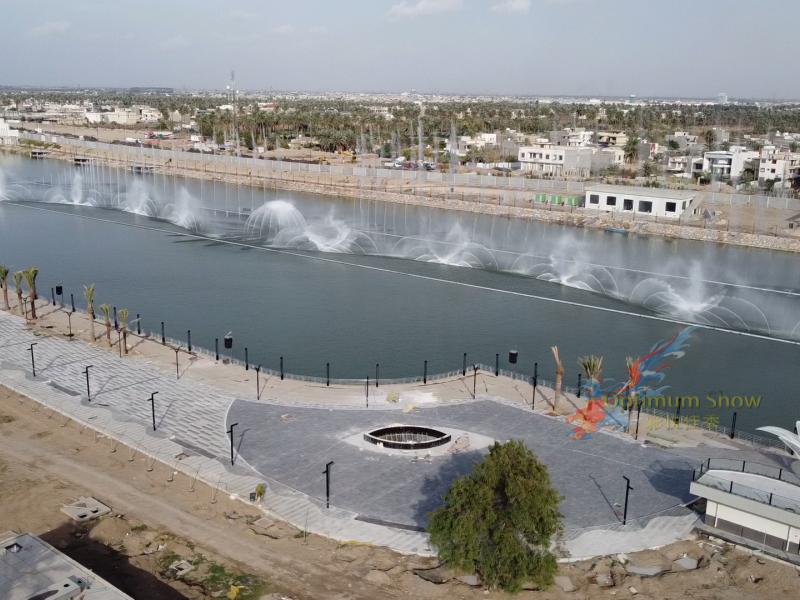
In one instance, waterside still takes the top honors. Where an existing lake installation is desired, a Floating Fountain is installed on cables and supplied from a shoreline panel, and it delivers a throw of 20 to 30 feet with no groundwork.
Cheapest honest path to huge outdoor water fountains by a country mile. For what it's worth, my old site foreman disagreed up until his last job, and he laid more concrete basins than anyone I have met.
⚠ Pro Tip: Stand where you will see it, at the time you will be there. You find out more at four in the afternoon than from any drawing.
Place a large water fountain where three things coincide: a flat area where it can sit with drainage, a power supply within 100 feet, and a view from a room that people actively use. Drop any one of those and the fountain simply becomes a maintenance activity instead of a feature.
There is a reason why dead center of a circular drive is the classic. The hard paving takes care of drainage, cars frame it, and headlights light it at night. Space the basin edge at least 12 feet away from the wheel path so tires never throw grit into the water.
Walk out from the window that is most frequently used, straight ahead, until the ground levels. That is your spot. A landscape large water fountain placed on axis to face a room is not decoration but architecture, and it provides an instant destination for each visitor without any sign or light directing him.
3. The Sunken Garden Or Natural Low Point
Water should flow to where water wants to go. Low points catch run-off, which eliminates the need for a second pump. Sunken gardens also capture sound and reflect it upwards, so a small Running Jets Fountain sounds like it has more power than its pressure appears to account for.
Moving water still belongs in narrow side yards and walled courtyards. Maybe 14 to 20 inches protruding from the face, a thin trough for draining, and no clear radius whatsoever is a wall large water fountain. Best option I know for tight urban estates and town house gardens.
Bronze fittings are attacked by chlorinated water, and nozzle bores become clouded in one season. Set the feature on its own separate recirculating loop 3 to 6 feet off the coping instead. You have the sound, you have the reflection, and your pool chemistry remains your pool's concern alone.
Open water has no match for scale. Locate a floating unit 60 feet or more from the bank so drift never soaks a path, run cable in conduit below the waterline, and make sure there is an isolator on the shore panel. Every pond large water fountain still requires boat access.
Split-levels conceal a surprise: the landing midway up. The water sits level with the visual line at this height, and the stair mass provides a location for burying pipework. My stairway plant rooms have saved me an area of garden space on three separate properties.
It is a different calculation if you put it inside. What is the enemy here? Not wind, it is humidity, so the key figures are the amount of water surface exposed and the extraction rate. A large indoor water fountain in a closed atrium can push any room past 70% relative humidity and warp joinery in a matter of months.
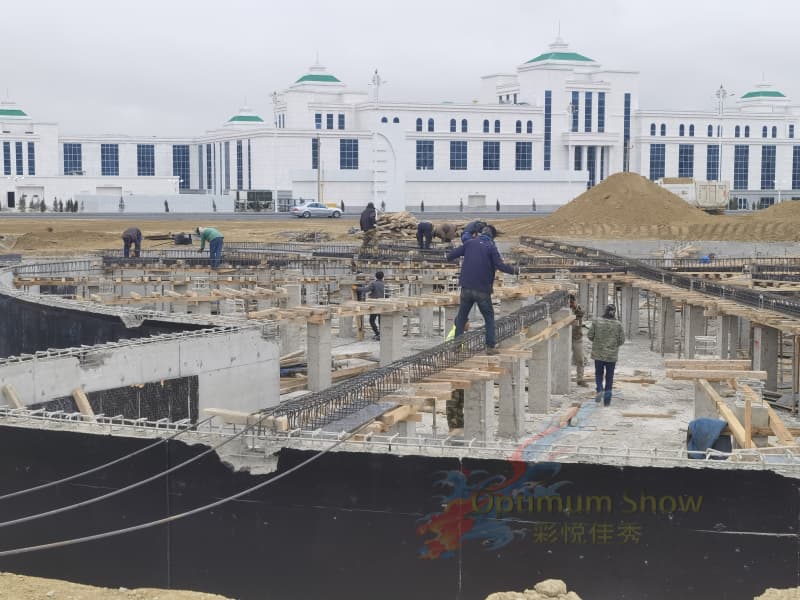
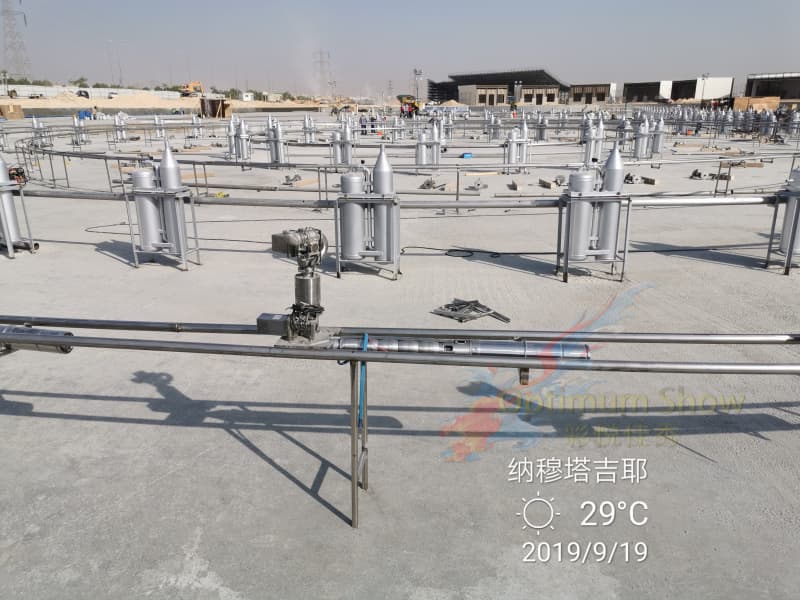
No one photographs this one, and more projects die out from this than from anything else. Pumps, filtration, and controls should sit in a dry place within approximately 100 feet of the basin, and there should be sufficient room to wheel a replacement unit through. Design that first, then place the fountain.
The fine spray from the jet is pushed sideways by the prevailing breeze at about three times the height of the jet. On a gusty afternoon, a 6-foot plume can wet paving as much as 18 feet downwind. Stroll the land, throw some dry sand, and observe where it falls. That 5 second test has saved me more remedial work than any software.
Wind sensors make up the difference. A basic anemometer cuts and adjusts the jet height beyond 12 mph, which saves the water bill and saves the man who has to squeegee the terrace.
Old trade rule, still in vogue: large fountain basin diameter is two times the maximum jet height. Six-foot jet, 12-foot bowl. This is a regulation that people constantly violate in order to shave costs on the basin, and then they top up the water they lose to evaporation and blow away for the next 10 years at triple the cost involved.
Pools of water next to a fountain are a slip and fall hazard. 1 to 2% slope on all surrounding paving, drainage channel along the low edge, done. Sounds obvious. Missed on approximately one third of the jobs I am called in to fix.
⚠ Warning: Retail scale does not equal estate scale. Home Depot, Lowe's, Walmart, Northern Tool, and Bunnings all top out around 60 inches and a quarter horsepower. Great for a patio, no problem. Hopelessly too small for a 90-foot drive court.
Use submersible fixtures rated IP68. They sit under water and illuminate the column from inside, and this is why the very best large outdoor water fountains with lights look nothing like a garden spotlight aimed at a bowl. Use 3 to 5 watts per gallon per minute of flow. Warm white for stone, cool white for metal, and do not use color change unless the property is an actual venue that hosts events.
A single trench, two conduits, one excavation. Dividing them into two digs across a now-completed lawn is how landscape budgets subtly double. The electrical side is addressed in NEC Article 680 in the US, and it wants ground-fault protection on every circuit that provides power to the feature. Not optional, and not something to argue about with the inspector.
Stone garden fountains that are tiered still sell out on traditional estates, and they count themselves lucky. Cast stone weathers well, the sound is soft and layered, and nothing else matches a formal parterre so well.
Modern outdoor fountains work the opposite way. Weirs, monoliths, sphere features, laminar arcs, all sheer. A large sphere water feature in polished granite with a thin film of water on top is perceived as a modern outdoor sculpture that is just happening to be wet, which was exactly its intention.
Plus, the floor variety, also known as a dry deck. A Floor Fountain has jets inserted in a grated slab, the water runs to a concealed storage tank, and the entire plaza is usable when the system is not in operation.
By far the best option for courtyard areas that also serve as a gathering place. Use flush jets in conjunction with a Crown Jets Nozzle array and you achieve a clean geometric crown at low pressure, about 18 to 30 psi depending on head height.
Others worth knowing:
First things first, there is a bit of confusion here, because the search results show two completely different things marketed together. A large cat water fountain for inside, a large dog water fountain, and a large pet water fountain bowl that moves outdoors are pet watering items, not landscape equipment.
Same words, different aisle completely. It is worth saying outright, because half the visitors who end up on this subject are actually shopping for their retriever.
Water fountain material holds more importance than shape. Shape is taste. Material is whether you still have it in 2046.
| Material | Freeze Performance | Weight (48-inch unit) | Lifespan | Relative Cost |
| Cast concrete | Poor, hairline cracks by year 5 | 900 to 1,400 lb | 8 to 15 years | Low |
| Cast stone | Fair with sealing every 2 years | 800 to 1,200 lb | 15 to 25 years | Medium |
| 316 stainless steel | Excellent, marine grade | 200 to 400 lb | 30 years plus | High |
| Metal, corrosive soils | Excellent, stabilizes in 18 months | 250 to 500 lb | 30 years plus | High |
Size is determined by viewing distance, not lot size. A general rule I have been following for years is that the feature should be approximately one tenth of the distance from where it is seen. 70-feet up from the terrace, you need something roughly seven feet tall. Push smaller than that and it goes out of the planting.
| Height Band | Best Placement | Clear Radius Needed | Typical Pump Draw |
| Under 80 inches | Tabletop, entry niche, indoor | 3 feet | 370 to 550 W |
| 80 to 120 inches | Patio corner, small courtyard | 5 feet | 550 to 1750 W |
| 120 to 160 inches | Garden bed, side lawn | 7 feet | 750 to 1.5 kW |
| 160 to 315 inches | Drive court, formal axis | 15 feet | 1.5 to 4 kW |
| Over 315 inches | Plaza, lake, grand entry | 15 feet plus | 4 to 7.5 kW |
Width bands work the same way. Under 40 inches and 40 to 80 inches are good for indoor and wall use, 80 to 160 inches is good for most free-standing garden items, 160 to 315 inches lands in real estate territory, and more than 315 inches wide will require a structural slab beneath it.
Now the number everybody wants. Water fountain cost consists of three components: purchase, install, and running.
| Cost Line | Mid-Size (48 to 60 inch) | Estate Scale (78 inch plus) |
| Unit purchase | $1,200 to $4,500 | $8,000 to $60,000 |
| Site works and plumbing | $900 to $3,000 | $6,000 to $40,000 |
| Electrical to NEC 680 | $600 to $1,800 | $2,500 to $12,000 |
| Annual water and power | $180 to $420 | $900 to $2,600 |
Municipal work is on another planet. If you have ever asked how much does a park fountain cost, US municipal budgets have varied from $75,000 for a simple interactive splash pad to in excess of $2 million for a choreographed fountain system with lighting and control.
⚠ Pro Tip: Request the pump curve from any supplier, not the horsepower. Horsepower sells. Flow at your actual head height is what fills the basin.
I hate to say it straight out, but a limitation is a limitation. A large fountain is a long-term maintenance relationship. Water levels monitored weekly, filters serviced monthly in most cases, seasonal shut-off in cold climates. Unless someone at the property will take ownership of that position, avoid the let down and purchase a sculpture instead.
So where does this leave you? Does the property have a grounds maintainer and a service agreement, or do you wish to have water during the weekends with no checklist? Ask yourself that before shortlisting anything, because it alters the material, the size, and the overall spec.
Twenty feet minimum for a 5-foot jet. Any closer and wind-blown spray reaches wall and window surfaces, which stains masonry over time. Include five feet of setback for each additional foot of jet height.
When the ground freezes in winter, the floater is lowered below the frost line. When the ice thaws in April or May of the following year, the floater is raised again.
Rarely. A sheet weir operates at approximately 40 to 50 dB at 10 feet, below normal conversation. Tall aerated jets produce 60 dB, so avoid placing those close to neighboring boundaries and bedroom windows.
Floating units in an existing pond. No dig, no basin, and no drainage work. A floating system provides a 20-to-30-foot fountain that is far less expensive to install than an equivalent built fountain.
The one thing to do before breaking ground is to stand still on the spot at four in the afternoon and observe which direction the wind blows a few specks of dust. That one test safeguards more budgets than any drawing. With all of our large water fountain designs, our engineering team at Optimum Show Fountain does exactly that. Wind wins.

Share your site size, water depth, location or CAD drawing with our engineering team. We can evaluate the project requirements and recommend a suitable fountain system.