A floating musical fountain starts differently than a fixed one. The process only really begins once floating has already been chosen as the right structure for the site. If that decision is still open, the guide to building a fountain show covers fixed vs. floating in more depth.
This guide picks up from there. It walks through platform design, anchoring, waterproofing, and installation — everything involved in getting a floating system running safely on open water. Floating musical fountains are most common on natural lakes, reservoirs, and resort lagoons, where pouring a concrete basin isn't practical or affordable.
The water itself becomes part of the show, which is why these projects tend to draw landmark-level attention in parks, waterfront developments, and tourism destinations. Each stage of building one carries its own engineering considerations, and each is worth walking through on its own.
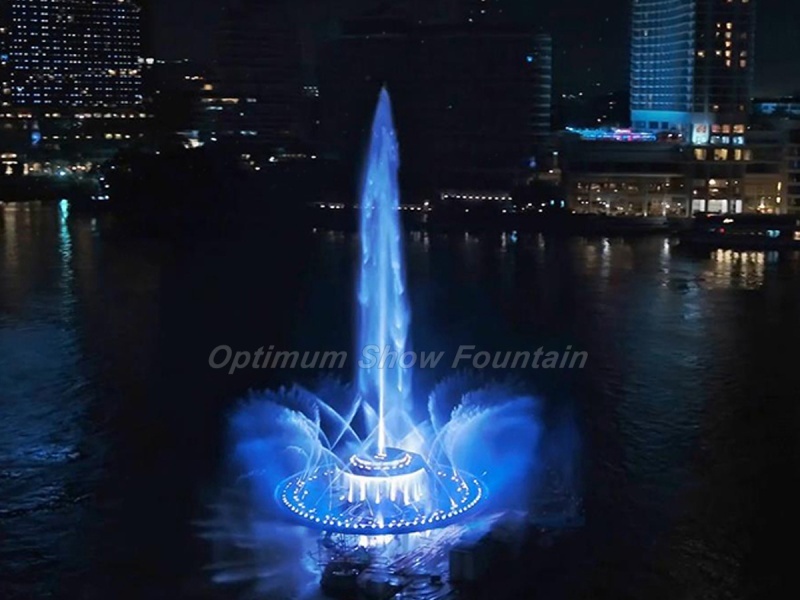
Most searches for a floating fountain turn up decorative pond units — built for aeration and a modest spray, not for choreographed water, light, and music. A floating musical fountain is a different category of equipment. It carries heavier pumps, more nozzles, a full lighting rig, and a control system that has to keep everything synchronized while the whole platform moves with wind and waves.
That combination — heavy equipment plus precise choreography — is what separates a floating musical fountain from the decorative units most manufacturers sell. Everything about the system carries a higher engineering margin than its fixed counterpart, simply because nothing on a floating platform stays perfectly still.
A fixed fountain's nozzles stay exactly where they're installed, since the basin itself doesn't move. A floating platform shifts slightly with wind, waves, and its own equipment vibration, so the structure, anchoring, and cable routing all have to account for movement a fixed installation never faces. Synchronization gets harder too, since every water, light, and audio cue depends on the platform holding a stable position.
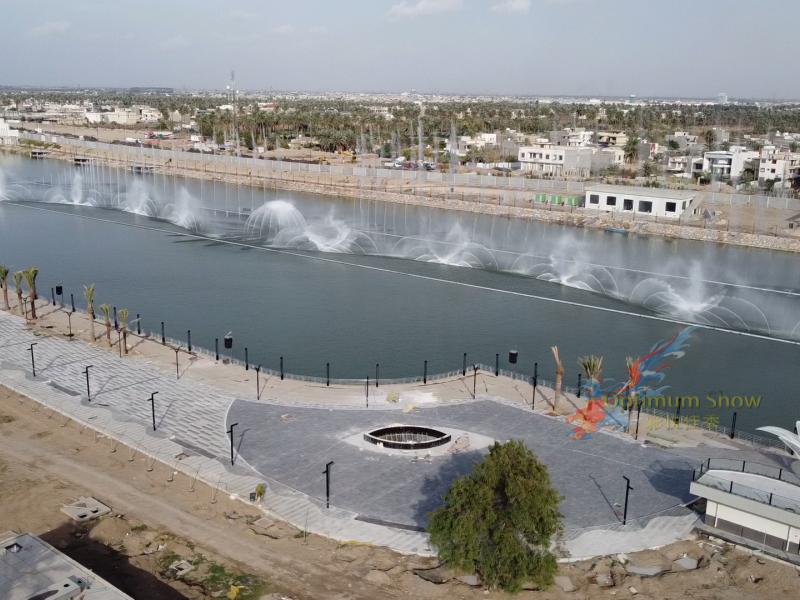
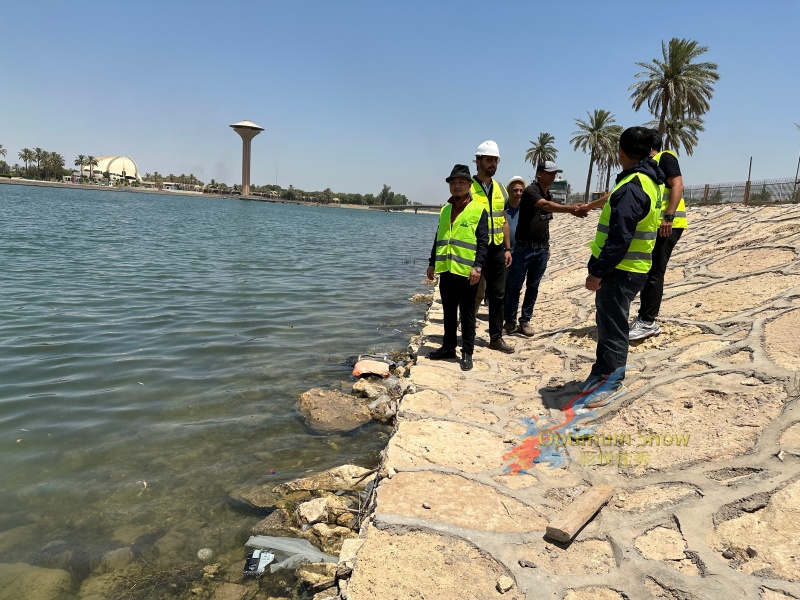
Every floating fountain project starts with a site assessment, and the water body itself sets most of the constraints. Water depth matters immediately — the platform and its anchoring system depend on knowing the minimum and maximum depth across the year, not just the depth measured on the day of the site visit.
Seasonal water level fluctuation is just as important. A lake that rises and falls by a meter or more, whether from dry-season drawdown or flood-season rise, needs an anchoring system built around that full range from the start — not just the conditions present during the first survey.
Bottom condition plays a role too. A soft, silty bottom holds anchors differently than a rocky or hard-packed one, which affects anchor type, embedment depth, and layout spacing. Wind exposure rounds out the structural side of the assessment — an open lake with a long fetch puts more lateral load on the platform than a sheltered cove, and it can distort jet shape and spray direction as well.
Water quality is easy to overlook next to depth and anchoring, but worth checking early. Saltwater, high mineral content, algae, and suspended sediment all affect pump wear, nozzle clogging, corrosion rates, and how often filtration and cleaning need to happen. None of these conditions rule out a floating system on their own — they just need to be identified before installation, not after.
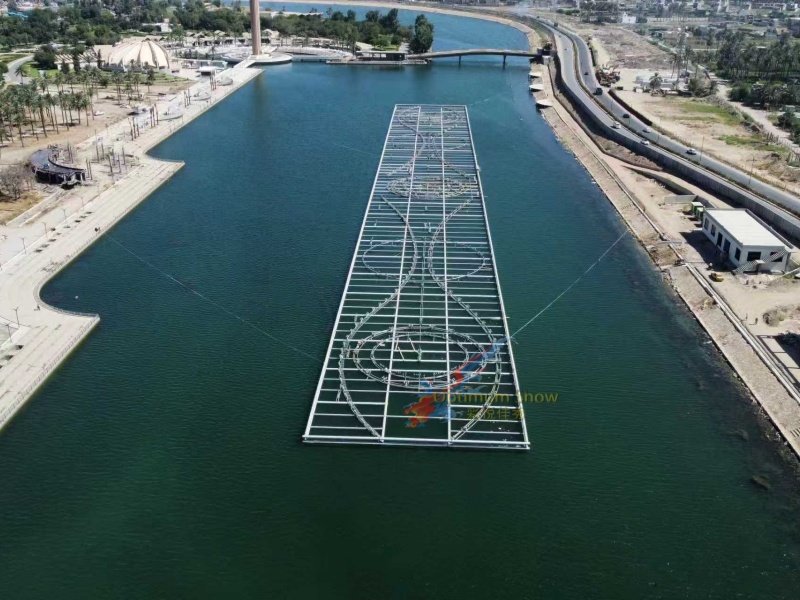
Once the site data is in hand, platform design starts with buoyancy. The float has to support the combined weight of pumps, nozzles, lighting, wiring, and the platform structure itself, plus a safety margin for added equipment or maintenance crews standing on deck.
Stainless steel and marine-grade carbon steel are the two materials most commonly used for musical fountain floats, chosen for corrosion resistance and long-term durability in constant water contact. HDPE modular floats are another option, especially for platforms assembled in sections and transported to remote sites.
Platform layout comes down to segmented versus unified construction. A unified platform is a single connected structure — simpler wiring, precise nozzle spacing, a good fit for smaller shows. Larger installations often go segmented instead, with float sections bolted together on site, shipped separately, and serviced section by section.
Maintenance access and future flexibility are worth building in from the start. Clear walkways, secure footing, and accessible junction points make routine servicing easier once the fountain is on open water. It's also worth leaving reserve buoyancy for equipment additions down the line.
Wind and current create one of the most demanding engineering challenges on any floating installation, and anchoring is where that challenge gets solved. A floating musical fountain has to hold a fixed position for its choreography to work — if the platform drifts even slightly, nozzle alignment shifts and the show stops matching its programming.
Cable and chain anchoring, run from multiple points on the platform to anchors set on the lakebed, is the standard approach for larger installations, since it can hold significant lateral load. Deadweight anchors — heavy concrete or steel blocks — are often used alongside cables in soft-bottom lakes.
Water level fluctuation is the second challenge every anchoring design has to solve. Mooring lines need enough slack to let the platform rise and fall with the season, without pulling taut or going loose enough for the fountain to drift out of position.
The mooring layout should be finalized during design, not adjusted casually once the platform is in the water. Reworking anchoring after equipment is already mounted is far more disruptive than getting it right the first time — which is why the water body assessment in step one carries so much weight later on.
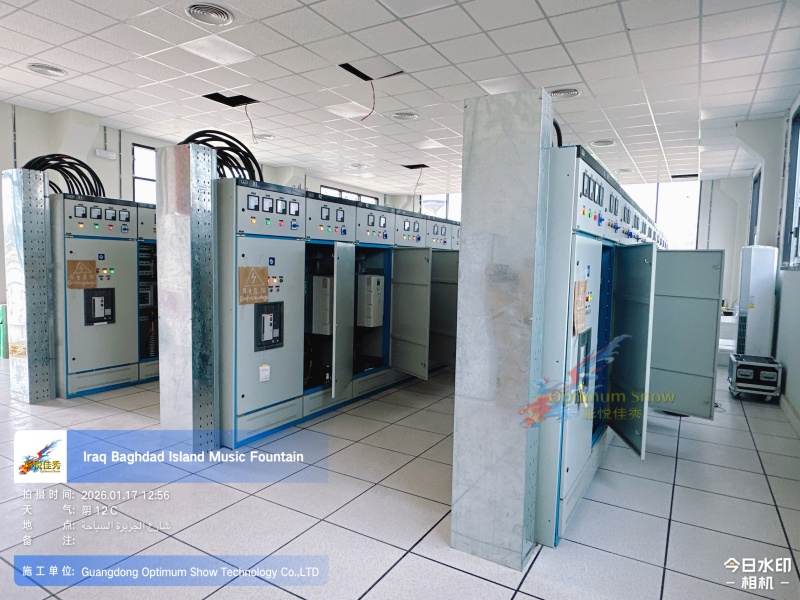
The control system for a floating musical fountain works largely the same way as it does for a fixed one. What changes is where the control room sits and how power gets out to the platform. The control room is normally built on shore rather than on the water itself, which keeps it accessible for daily operation and easier to protect.
Distance between the control room and the platform matters for cost. As a general rule, keeping that run within roughly 150 to 200 meters helps manage cable costs, since longer distances call for a heavier cable specification to avoid voltage drop and signal loss. Every cable serving the pumps, lights, and solenoid valves on the platform runs from the floating structure back to the control cabinet on shore, so this distance is worth factoring into the site layout early rather than adjusting for it later.
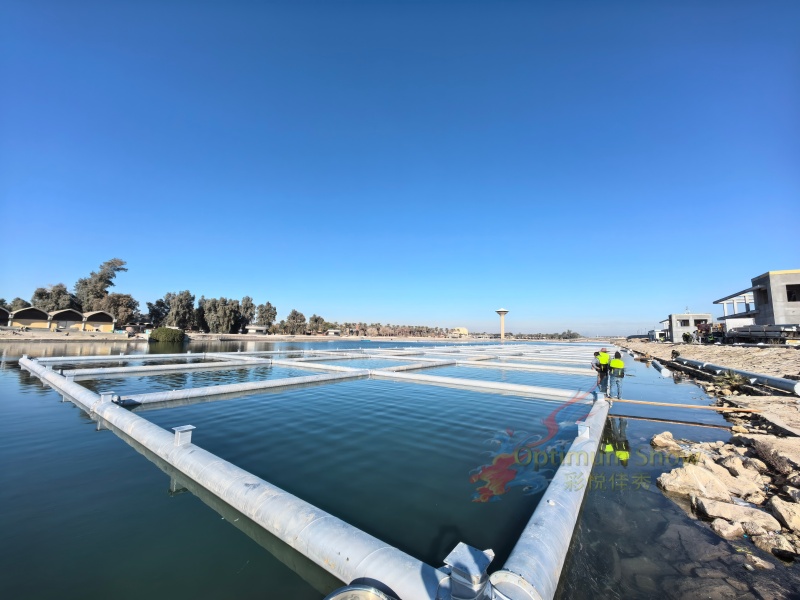
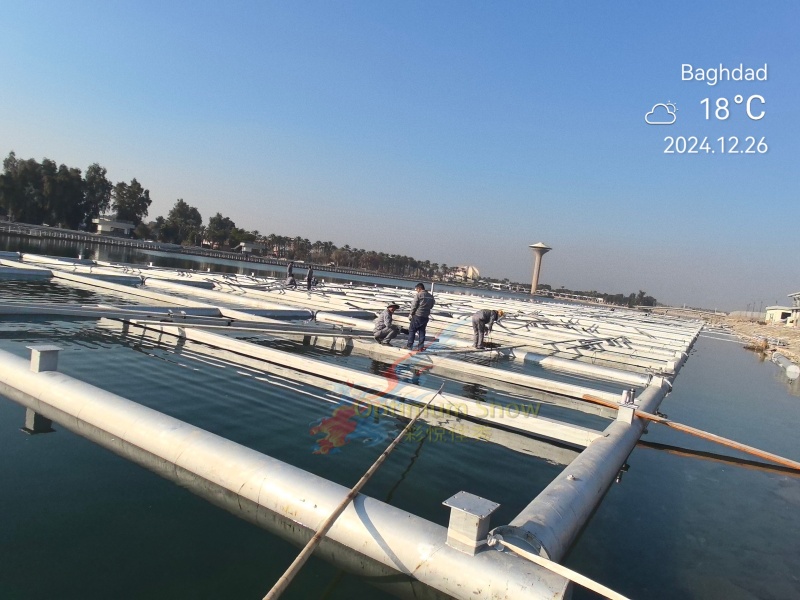
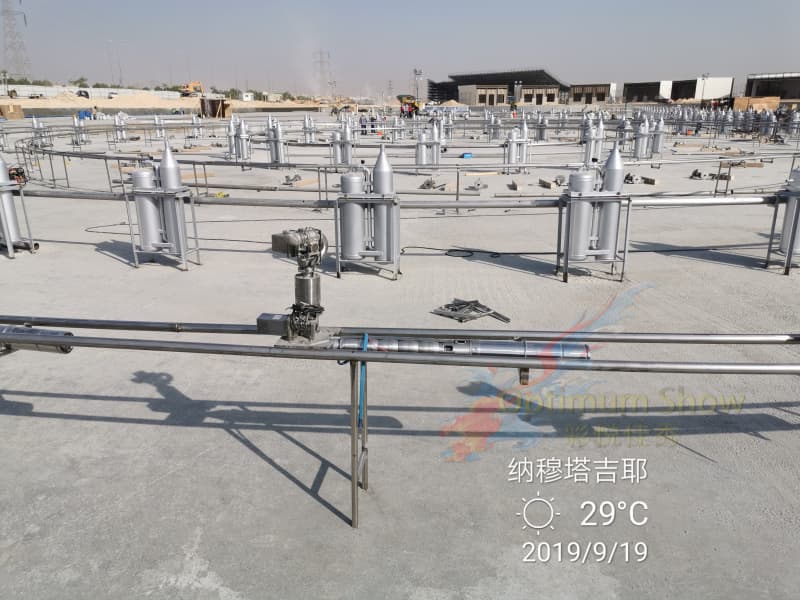
Installation on water follows a different sequence from a fixed fountain. For many floating musical fountain projects, the floating pontoon system is first assembled on shore, because connecting frames, pipes, and float modules on solid ground is more efficient and easier to control.
In some projects, the floating modules can also be assembled directly on the water. In this case, each floater section is connected one by one, and the pipework is joined progressively until the full floating platform reaches the designed layout.
Once the floating platform is assembled, it should be checked for balance, level flotation, and load distribution before it is moved into its final position. Any uneven loading should be corrected at this stage, before the platform is fully anchored.
After positioning is confirmed, the anchor lines are set and tensioned according to the mooring design. The platform must remain stable under wind, wave movement, water-level changes, and equipment load before the fountain equipment is installed.
After the floating pontoon system is assembled and positioned, the next stage is to install the functional fountain equipment on the platform.
First, the submersible pumps are placed and fixed securely onto the floating structure to prevent movement or vibration during operation. Then the LED lights, DMX512 nozzles, digital jets, and other water-effect equipment are mounted according to the hydraulic and choreography layout.
Each nozzle and light must be aligned carefully to ensure the correct water height, spray direction, lighting angle, and visual effect. This is especially important for musical fountain shows, where water movement, lighting, and music must remain synchronized.
After the pumps, lights, and nozzles are fixed, waterproof power cables and control cables are routed along the floating platform. Protective conduits, cable trays, and strain-relief points should be used to protect the cables from movement, water exposure, and long-term wear.
Finally, the cables are extended from the floating platform to the shore and pulled into the central control room, where they connect to the power distribution cabinet and automatic control system. Once this stage is complete, the system is ready for wiring checks, insulation testing, and initial operational testing.
Commissioning starts the same way it would for a fixed installation — electrical checks, grounding verification, and a wet test without choreography to confirm every pump, nozzle, and light responds correctly on its own.
From there, the programmed show runs end to end, with pump pressure, nozzle angles, and lighting cues adjusted until the water pattern matches the choreography software. Real-world performance can differ slightly from a simulation, so this stage usually involves some fine-tuning.
A stability and trim check is specific to floating systems and shouldn't be skipped — the platform needs to sit level without listing from uneven weight distribution, and divers or a service boat typically verify anchor tension at this stage too. It's also worth reviewing the show from the actual audience viewing areas, since water height and lighting can read differently from a distance.
Long-term maintenance carries a different profile on a floating system than a fixed one — most of the attention goes to the platform and its anchoring rather than the fountain equipment itself. Anchor lines and connection points need periodic inspection for corrosion and wear, since they carry constant tension and sit fully submerged.
The float structure should be checked for buildup too. Algae, sediment, or debris collecting around the base can affect buoyancy and stability over time, and underwater electrical connections deserve closer attention than their dry-land equivalents, since a small failure is harder to spot early.
Maintenance access is worth planning alongside the platform itself — a service boat, removable sections, or a dedicated shore access point, whatever makes servicing realistic without disrupting the show schedule. A simple log of anchor tension and cable condition helps catch small issues before they become bigger repairs.
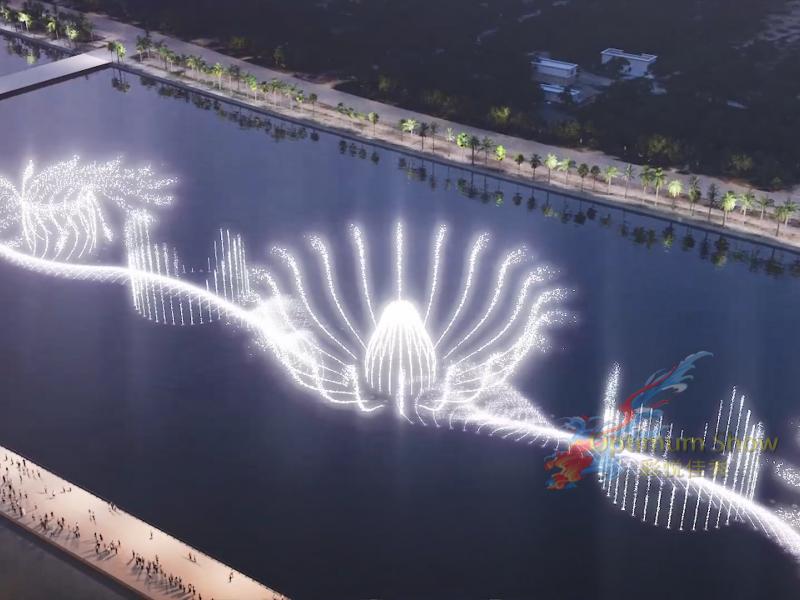
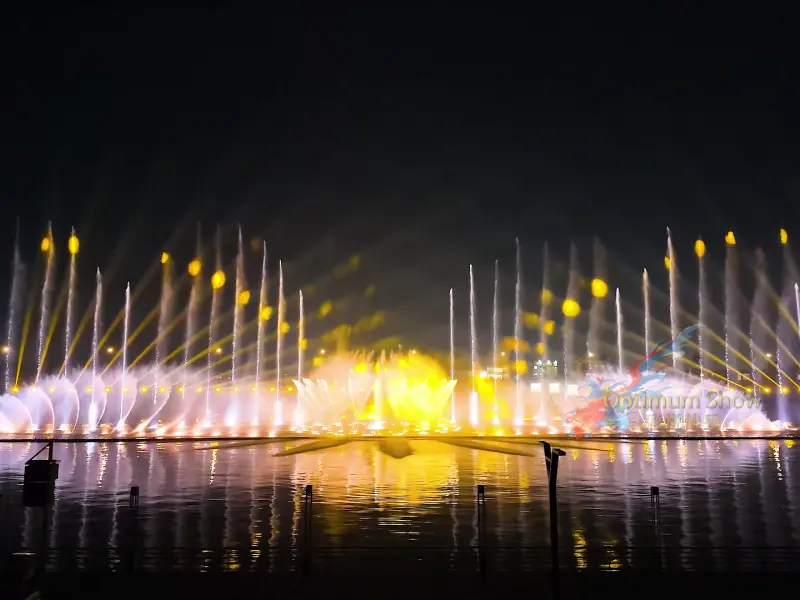
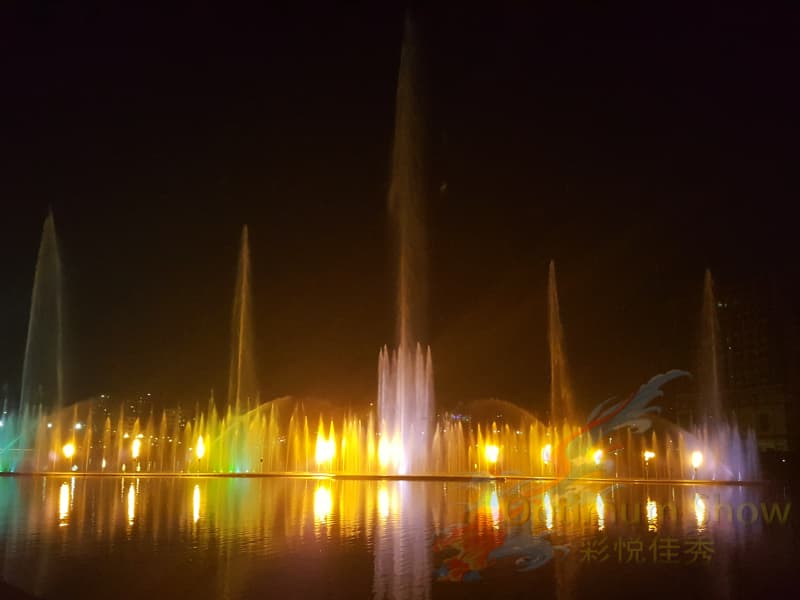
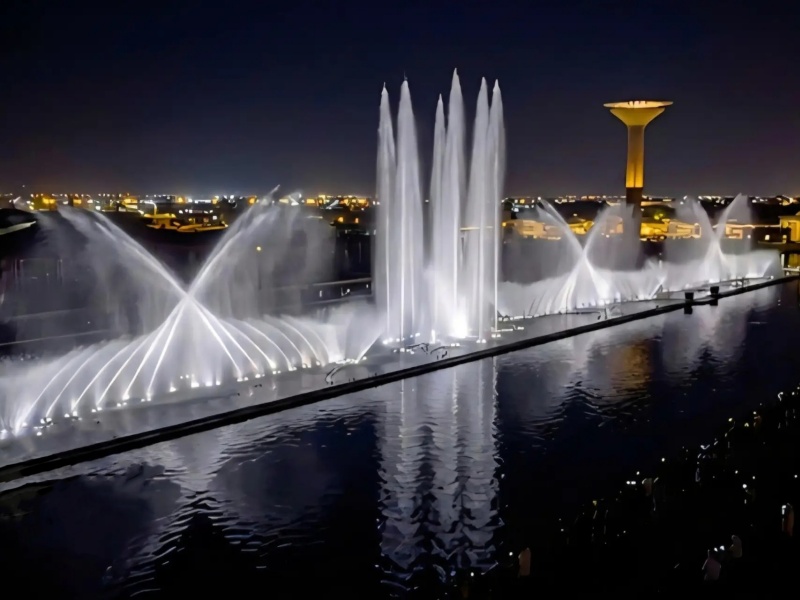
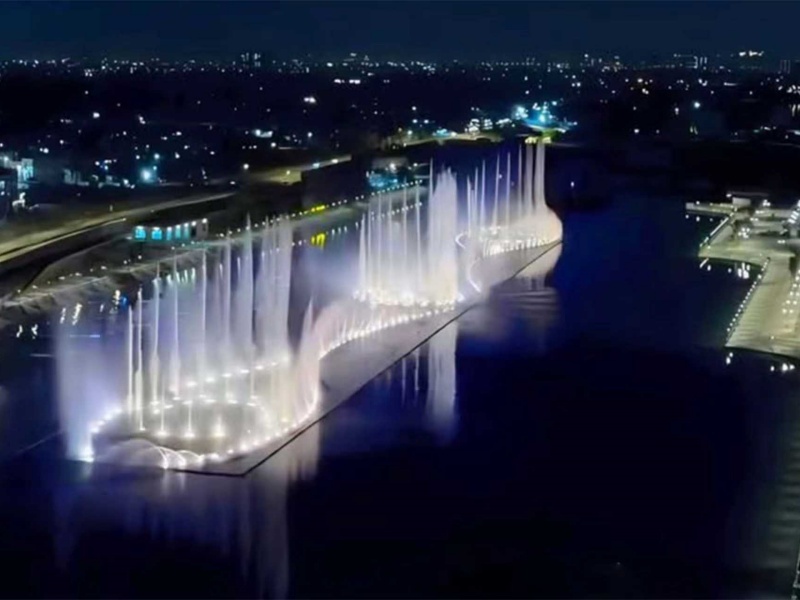
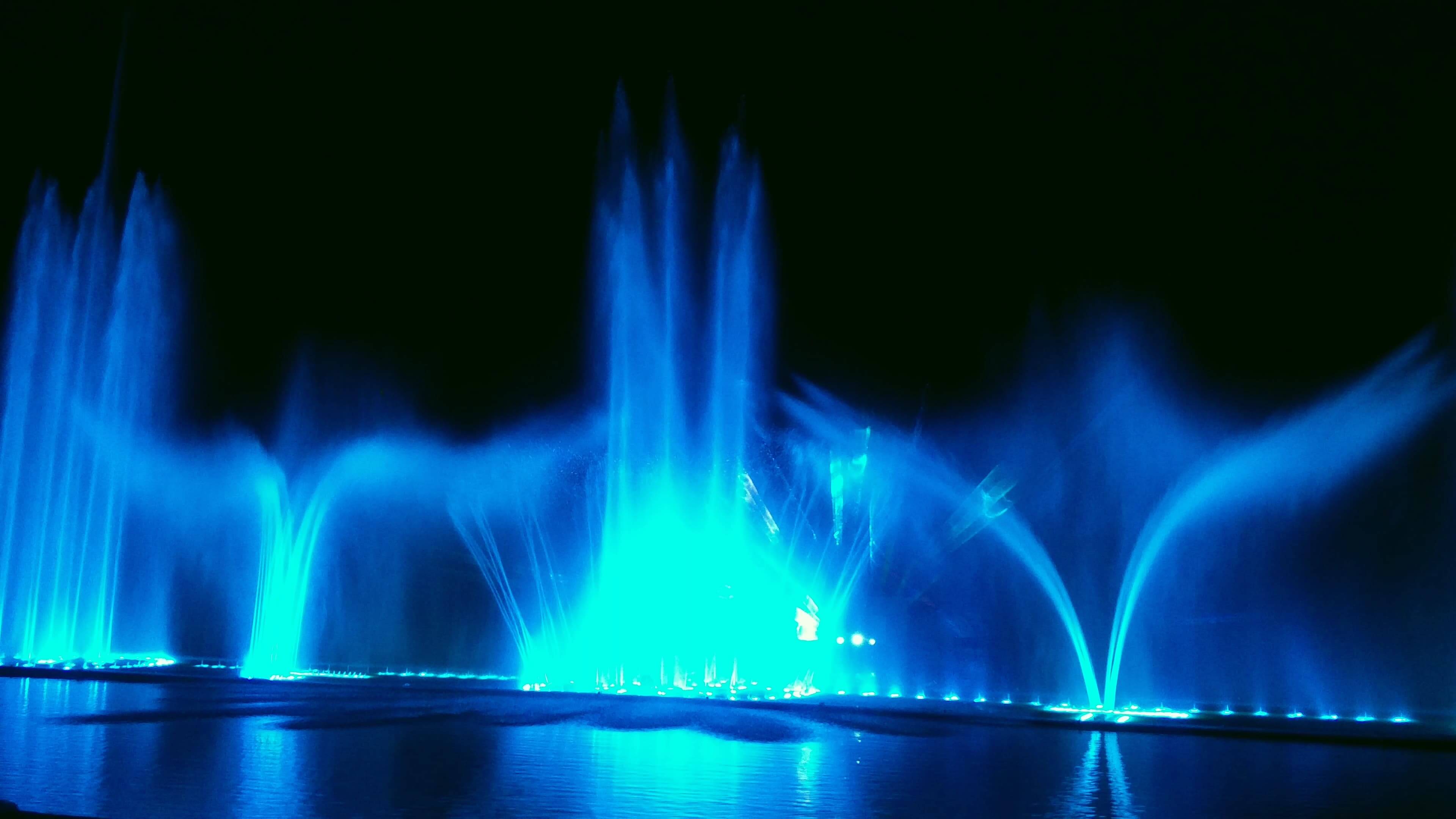
The floating musical fountain at Baghdad Island in Iraq shows how a lake-based fountain project becomes a full engineering system rather than a simple floating display. The installation spans roughly 300 meters in length and 33 meters in width, making it a large-scale floating musical fountain project in the region, and combines water, lighting, laser, and multimedia effects into one synchronized show.
The system integrates around 1,000 sets of digital fountain nozzles, roughly 1,000 submersible pumps, approximately 2,000 digital LED lights, full-color laser systems, and 100 waterproof beam lights, alongside air-explosion effects and water-screen movie projection, all coordinated through a DMX512-based multimedia control system that keeps water, lighting, laser, and music sequences running as one programmed performance.
For a floating installation of this scale, the challenge goes beyond show programming. The platform has to stay stable, the anchoring system has to control drift, and the hydraulic layout has to hold water effect alignment across the full show area. A project like this requires coordinating structural design, hydraulic engineering, manufacturing, installation, programming, and long-term support — the same sequence covered in this guide. Optimum Show delivered Baghdad Island end to end, drawing on more than 5,000 completed projects across 80+ countries.
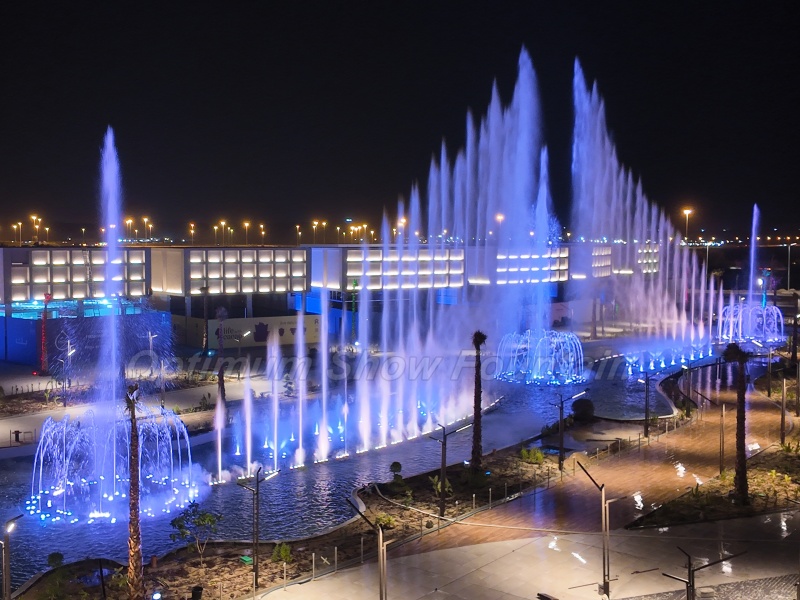
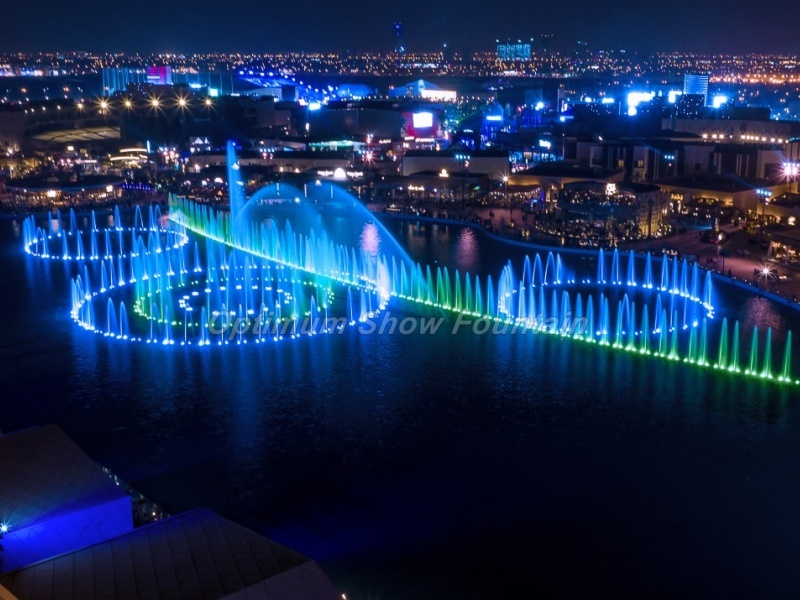
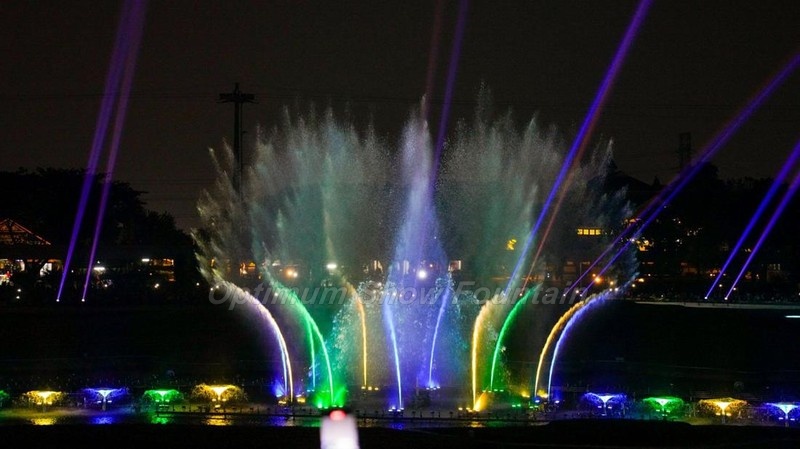
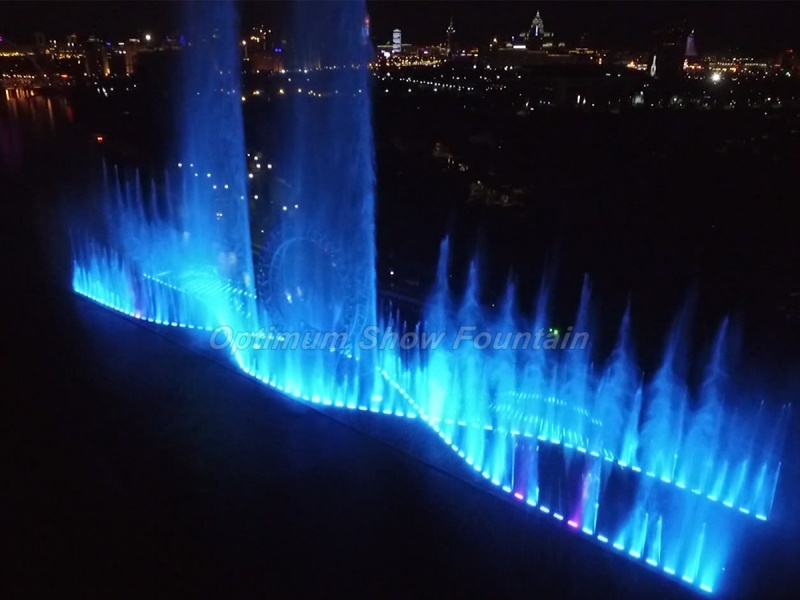
Baghdad Island is the largest floating musical fountain Optimum Show has delivered, but not the only one. The Big O Show in Kazakhstan is a 180-meter installation built around a giant O-shaped water formation over 17 meters across. The Dal Lake floating fountain in Srinagar, India combines a fountain and water screen system anchored in water roughly 6 meters deep. Wonder Park Iguaçu in Brazil features a 60-meter floating fountain synchronized with music and lighting, and the Hatirjheel Lake fountain in Dhaka, Bangladesh spans 120 meters with jets reaching 80 meters. Each project required a different approach based on water depth, site access, climate, and show scale.
Every floating musical fountain starts with the same first step: understanding the water body it will sit on. Depth, wind exposure, water quality, and seasonal level changes shape every decision that follows, from platform material to anchor type.
If you're planning a project for a lake, reservoir, or waterfront site, Optimum Show's engineering team can walk through a site assessment and help scope what a floating system would look like for your location.
A standard floating fountain is a decorative or aeration unit designed to circulate water and create a simple spray pattern, usually without lighting or music. A floating musical fountain adds choreographed water movement, lighting, and music synchronization, which requires more nozzles, a full control system, and a platform engineered to hold significantly more equipment weight.
It depends on the site. A floating system avoids the cost of pouring a concrete basin, but the platform, anchoring, and waterproofing requirements add their own costs, so the total often lands in a similar range to a fixed installation of comparable size.
Yes, floating platforms can support laser, projection, fog, and fire effects alongside the water and lighting show, though each of these usually needs its own control integration rather than plugging directly into the base DMX setup. Multimedia laser show covers how these systems layer onto a fountain's core choreography, and site conditions like viewing distance and safety clearance influence which effects are practical for a given location.
Yes, but saltwater sites need extra corrosion protection built into the design from the start — sacrificial anodes, higher-grade stainless steel or coated components, and sealed electrical connections rated for a marine environment. This gets factored into material selection and maintenance planning during the site assessment rather than added afterward.
Timeline depends heavily on platform size, choreography complexity, and site access, so it's evaluated project by project rather than quoted as a fixed range. The fountain show guide covers the factors that generally drive timelines up or down.
Share your site size, water depth, location or CAD drawing with our engineering team. We can evaluate the project requirements and recommend a suitable fountain system.