A musical fountain at its best is something people stop to watch. Water climbs and falls in perfect sync with the music; light shifts color on the beat; every jet finds its cue without hesitation. That experience doesn't happen by accident — and it certainly doesn't sustain itself.
Musical fountains are continuous electromechanical systems. They integrate variable-speed pumps, precision nozzles, DMX-controlled LED lighting, professional audio equipment, and programmable control software — all operating together, typically for multiple shows per day. When any one layer of that system is neglected, the entire show suffers. When maintenance is structured and consistent, these installations routinely perform for fifteen to twenty-five years with high show quality and manageable costs.
This guide gives operators, facility managers, and technical teams a single reference covering every maintenance task from daily pre-show checks to annual specialist overhauls — and everything in between.

Most facility managers understand that machinery needs maintenance. What's less widely appreciated is just how demanding musical fountains are compared to other electromechanical assets of similar scale.
A standard decorative fountain runs one pump at a fixed speed and may have a handful of static LED lights. A musical fountain might run twenty or more pumps simultaneously, cycling them at varying speeds dozens of times per show, while a DMX controller fires hundreds of lighting cues and a PLC sequences every nozzle movement to within milliseconds of the music track. That complexity multiplies failure points — and removes any tolerance for casual maintenance.
Poor maintenance creates a cascade. A clogged nozzle breaks the visual symmetry of the show. A pump running below design efficiency drops water pressure across an entire zone. A corroded connector pulls an LED ring out of a synchronised colour sequence. None of these failures gives a warning; they all happen during a show, in front of an audience.
From a business perspective, the case is equally direct. Organisations with structured preventive maintenance programmes consistently spend three to five times less on repair costs over five years than those operating reactively. Maintenance isn't an expense — it is downtime insurance.
Before establishing a maintenance schedule, it helps to understand what each subsystem actually demands — because the failure modes differ significantly across components.
1. Pumps and VFDs — Submersible and centrifugal pumps govern water pressure and flow rate. Variable Frequency Drives (VFDs) enable real-time jet height variation by cycling pump speeds dozens of times per show; their enclosures must remain clean, dry, and well-ventilated. Dust ingress into a VFD cooling fan is a slow-motion failure that culminates in an expensive board replacement.
2. Nozzles — Foam, laminar, mushroom, and crown nozzles are vulnerable to mineral scale; even minor deposits visibly alter spray patterns. Digital 2D/3D swing nozzles additionally require precision alignment checks — their moving parts introduce mechanical wear that fixed nozzles don't.
3. Underwater LED lighting — IP68-rated fixtures are controlled via DMX512. Seal integrity is their primary vulnerability: water ingress past a degraded gasket causes rapid driver failure and, in wet environments, creates electrical safety risks.
4. Audio and control systems — The central PLC and DMX controller run the choreography software that synchronises every component. Show files represent months of programming work and must be backed up regularly; a UPS on all control circuits prevents file corruption during power events.
5. Basin and civil infrastructure — Waterproofing membranes, drainage channels, and stainless manifolds are easy to overlook because they're hidden. But a failing membrane or corroding joint causes far greater disruption than any nozzle clog — and is far more expensive to repair.

Effective maintenance follows a tiered responsibility model. Operators handle daily and weekly routines that keep each show running safely. Trained technicians manage monthly deep-service visits that keep components healthy between seasons. Specialists conduct quarterly calibrations and annual overhauls that sustain long-term system integrity. The table below maps every task to the correct frequency, responsible party, and measurable pass criteria.
| Frequency | Area | Who | Core Tasks | Pass Criteria |
| Daily | Visible areas | Operator | Visual check · Water level · Debris removal · Pre-show system test | No leaks · Nozzles aligned · All zones active |
| Weekly | Water system | Operator | pH & biocide test · Filter basket clean · Lighting spot-check · Log all readings | pH 7.2–7.6 · Chlorine 1–3 ppm · No flickering |
| Bi-weekly | Nozzles & filters | Tech team | Nozzle deep-clean · Backwash filters · Clear pump inlet screens | Full spray pattern · No mineral deposits |
| Monthly | Full system | Technician | Pump inspection · Electrical audit · LED gasket check · Control system log review · Pipe flush | No cavitation · All zones respond · Earth continuity OK |
| Quarterly | Control & structure | Specialist | DMX re-calibration · Software backup · Structural inspection · Thermographic scan | Sync ±50ms · No thermal hot-spots |
| Seasonally | Full system | Tech + Specialist | Winterisation / Spring recommissioning | All pipes drained · Settings archived |
| Annually | Full overhaul | Specialist | Basin drain · Megger test · Firmware update · Full electrical compliance · SOP review | Compliance certified · All records updated |
Daily Tasks
Before every show, operators should confirm:
Weekly Tasks
Monthly Tasks
Quarterly and Annual Tasks
While the schedule defines when maintenance should be performed, this section explains how each system should be maintained and what risks to monitor.

Water chemistry affects every subsystem simultaneously — which is why it's the highest-leverage variable in the entire maintenance programme. Getting it wrong doesn't just produce bad-looking water; it accelerates corrosion inside pipework, degrades LED gaskets from chemical exposure, and clogs nozzle orifices with mineral deposits faster than any cleaning schedule can keep up with.
The parameters to track and why they matter:
In hard-water regions (above 200 ppm CaCO₃), scale inhibitors or water softeners should be part of the system design — monthly nozzle descaling alone cannot outpace active scale deposition. For open-air installations in hot climates, partial water changes of 30–50% every two to four weeks are typically necessary regardless of chemical balance. Automated dosing systems pay for themselves quickly in large installations by eliminating the variability of manual treatment.
Pumps are the highest-cost components to replace and the most disruptive to the show when they fail mid-performance. The monthly inspection targets early signals, not end-stage failure:
Proactive seal replacement at 18–24 months — before failure rather than after — is standard practice. A seal replacement takes 30 minutes; a seal failure that allows water into the motor takes the pump out of service for days.
The purpose of monthly nozzle cleaning is not just to remove visible blockage — it's to maintain orifice geometry. Mineral deposits don't always fully block a nozzle; more often, they partially restrict it, changing jet height and spread angle in ways that are visible to the audience but not immediately obvious to a ground-level inspection. Always test the spray pattern against the commissioning baseline after reinstalling, not just visually from ground level.
When cleaning:
Monthly pipeline flushing is about biofilm, not just debris. Biofilm — the thin bacterial layer that accumulates on pipe walls in recirculating water systems — progressively reduces pipe diameter and provides a substrate for further contamination. Flushing with clean water at a velocity disrupts it before it consolidates.
The IP68 gasket is the most frequently overlooked failure point in underwater LED systems — because it passes visual inspection long after it has begun allowing moisture ingress under operating pressure. Physical compression testing is required: press each gasket firmly; if it doesn't spring back or shows surface cracking, it needs replacing regardless of appearance.
What to watch for beyond the gasket:
Keep spare LED drivers on-site for every fixture type installed. Driver failure is the fastest-turnaround repair in the lighting system if a spare is available; it becomes a multi-day delay if it isn't.
Maintaining the control system of a musical fountain demands precise attention to detail and technical expertise. Regular maintenance is vital to guarantee seamless operation and synchronization.
Key practices include:
Such meticulous strategies are essential for delivering innovative and reliable musical fountain experiences.
Musical fountains often face issues such as nozzle clogging, pump failure, and water quality deterioration, which can impact their performance and aesthetics.
Addressing these requires regular maintenance, including cleaning nozzles, inspecting pumps for cavitation, and monitoring water quality.
Additionally, resolving control system faults and LED lighting failures is essential for ensuring synchronized operations and vibrant displays.
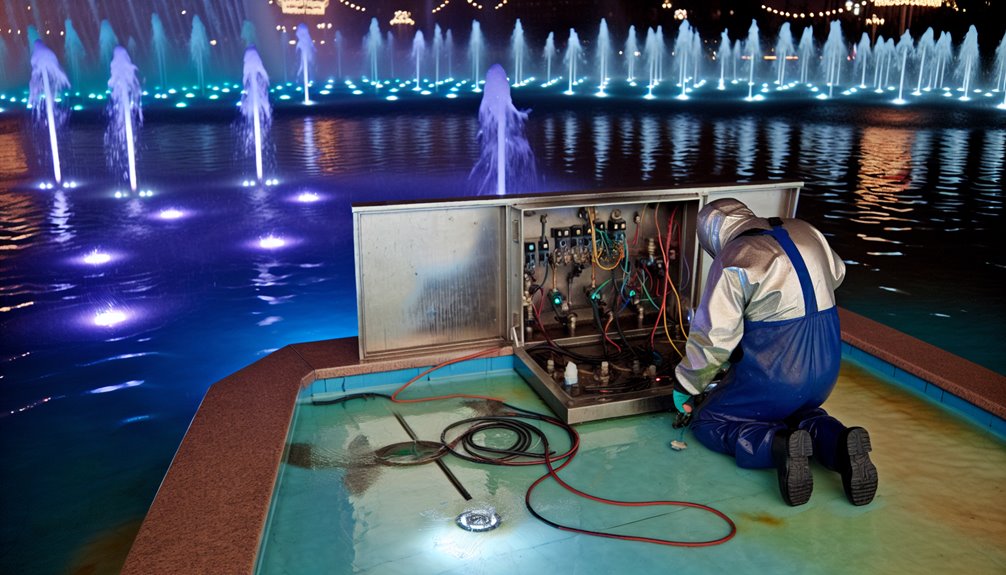
Symptoms: Uneven spray pattern; reduced jet height; asymmetric water shapes during show.
Causes: Mineral scale buildup from hard water; algae or biofilm entering the orifice; debris from basin bypassing the pre-filter.
Fix: Disassemble and soak the nozzle in citric acid or commercial descaler for 30–60 minutes. Flush with clean water. Inspect the upstream basket filter for bypass. Test spray pattern individually before reinstalling.
Prevention: Monthly cleaning schedule regardless of visible buildup. Weekly water quality management to control TDS and scale. Bi-weekly pre-filter inspection.
Symptoms: Grinding or rattling noise from the pump; reduced flow rate in the affected zone; pump zone tripping circuit breaker; visible surface turbulence at the pump intake.
Causes: Insufficient water depth above pump intake (cavitation); worn impeller blades; mechanical seal failure; clogged inlet screen; VFD parameter error causing operation below minimum frequency.
Fix: Check and clear inlet screens immediately. Verify basin water level against pump specification. Inspect the impeller for blade damage. Test run the capacitor on single-phase pumps. Review the VFD minimum frequency parameter. Do not run the pump until the root cause is confirmed.
Prevention: Maintain a minimum basin water depth at all times. Annual impeller inspection. Proactive seal replacement at 18–24 months. Quarterly VFD parameter verification.
Symptoms: Green or cloudy water; foam accumulating on basin surface; unpleasant odor; visibly discolored water plume from nozzles.
Causes: Algae bloom caused by pH imbalance combined with insufficient biocide; biofilm accumulation on basin walls and pipework; heavy organic load from leaf litter or bird activity.
Fix: Shock treatment with an appropriate biocide at an elevated dose. Partial water change of 30–50 percent. During the change, scrub the basin walls and clean the filter. Backwash or replace filter media.
Prevention: Weekly water quality testing and logging. Consistent biocide dosing schedule. Daily debris removal from the basin surface. Minimum 8-hour daily circulation.
Symptoms: Nozzles firing out of sequence; lights not responding to music; entire zone offline; show timer displaying incorrect time.
Causes: DMX cable fault or incorrect termination (≤120Ω termination required at line end); control software crash or corrupted show file; relay or contactor failure; power fluctuation corrupting active settings.
Fix: Check DMX line continuity with a DMX tester. Reboot the controller and reload the show file from the most recent verified backup. Inspect relay contacts for pitting. Review the software event log for fault codes before assuming hardware failure.
Prevention: UPS on all control system circuits. Surge protection on all panels. Monthly software backup to off-site or cloud storage. Quarterly DMX signal integrity test.
Symptoms: Dead zones in lighting; flickering fixtures; color inconsistency across zones; entire lighting circuit going offline.
Causes: Water ingress past a degraded IP68 gasket; cable chafing in high-flow zones adjacent to nozzle jets; LED driver failure; loose or corroded DMX connector.
Fix: Test each fixture with a multimeter to distinguish driver failure from LED module failure. Replace the failed gasket and re-seal with appropriate silicone. Inspect and re-secure cable glands. Swap the LED driver if voltage is present at the input but no output.
Prevention: Monthly IP68 gasket inspection at every service. Marine-grade stainless steel fittings in saltwater or high-chlorine environments. Spare LED drivers are maintained on-site. Annual thermographic scan of all electrical connections.
Symptoms: Water patterns visibly lagging behind the music; choreography appearing 'off'; random nozzle firing inconsistent with the show file.
Causes: DMX channel timing drift after a power event or firmware update; audio signal latency from buffer setting changes; show file corruption; VFD ramp-up or ramp-down time misconfigured after parameter reset.
Fix: Recalibrate DMX channel timing offsets in the control software. Adjust audio buffer settings to match the original commissioning configuration. Reload the verified show file from backup. Review and reset VFD ramp parameters to specification.
Prevention: Quarterly show synchronization calibration session. Maintain a verified show-file backup after every programming update. Document VFD ramp parameters in the system record so they can be restored after any parameter reset.
Proper seasonal maintenance is essential for the longevity of musical fountains, encompassing winterization and spring recommissioning processes.
Winterization involves a detailed checklist that includes draining water, protecting pumps, and securing nozzles to prevent frost damage in cold climates.
As spring approaches, recommissioning requires a thorough system inspection, reactivation of pumps and nozzles, and testing of all electronic components to guarantee seamless operation.

As winter approaches, ensuring the longevity and functionality of musical fountains in cold climates requires meticulous preparation. Implementing a detailed winterization checklist helps prevent damage from freezing temperatures.
Key steps include:
Logging shutdown dates and conditions sets a baseline for future recommissioning.
Effective spring recommissioning is crucial for restoring musical fountains to their full operational capacity after winter. The process begins with a full basin inspection to identify winter-induced cracks in the waterproofing membrane.
Reinstallation of pumps and fixtures follows, guaranteeing all cable glands, conduit seals, and IP68 gaskets are intact. Flushing the entire pipe system with clean water removes winter debris before nozzle reconnection.
Each fountain zone is tested independently to verify functionality prior to a full show run. Recalibration of DMX channel mapping and audio synchronization is essential after powering up.
Performance metrics are compared against pre-shutdown baselines, with deviations over 10% warranting investigation. Documenting the recommission date and component statuses guarantees thorough records for future reference.
While maintaining musical fountains, understanding the distinction between maintenance and repair is essential.
Maintenance involves planned, scheduled actions to prevent failure, extend lifespan, and sustain performance, offering predictable and low costs per event. In contrast, repair is reactive, addressing failures after they occur, often at unpredictable costs including emergency labor and potential losses from show cancellations.
Planned maintenance prevents failures and reduces costs, unlike unpredictable and costly reactive repairs.
In well-documented case studies across mechanical systems, organizations with structured preventive maintenance programs consistently spend three to five times less on total repair costs over a five-year period than those operating reactively. For public-facing attractions like musical fountains, the reputational cost of a visible failure adds further weight to the preventive case.
A maintained asset also retains higher residual value at disposal or upgrade time, and a complete maintenance history simplifies warranty claims with component manufacturers. There is no scenario in which reactive maintenance is the economically rational strategy for a musical fountain installation.
The best maintenance schedule in the world is only as good as the people executing it. Technical knowledge doesn't transfer automatically; it has to be deliberately taught, documented, and refreshed as personnel change.

Improper operation is the single largest category of preventable equipment failure in musical fountain systems. The failure mode appears repeatedly across installations of every scale: an operator who wasn't trained to verify water level before pump start causes a seal failure; an operator who wasn't shown how to identify cavitation noise lets a damaged impeller run for three weeks; an operator who didn't know the correct shutdown sequence corrupts a show file. None of these failures are malicious — they are the predictable result of insufficient training.
The risk compounds with staff turnover. If operating knowledge lives only in the heads of experienced personnel and not in documented procedures, it disappears when those people move on. For public-facing attractions with high audience expectations, that knowledge loss can be catastrophic.
A well-structured Standard Operating Procedure (SOP) ensures consistent, safe, and efficient operation of a musical fountain system. It should clearly define responsibilities, actions, and response thresholds.
Key elements include:
This structured approach minimizes operational risk, reduces downtime, and ensures the fountain system maintains stable, long-term performance.
Every maintenance action should be recorded — the date, the person performing it, what was checked or serviced, and the outcome or any observations. Digital logbooks enable trend analysis that a paper record cannot: a pump drawing steadily more current month over month, a filter requiring backwashing more frequently, a water test result drifting toward the edge of the acceptable range — these patterns are visible in a digital log and invisible in a pile of paper forms.
Maintenance records also serve a second function: they are your evidence in any warranty claim, insurance event, or regulatory inspection. A complete, signed, dated log demonstrating regular professional service is worth more than any verbal account of the care that was taken.
Optimum Show provides customized maintenance training programs, SOP development, and ongoing technical support for all fountain installations. Our service team works with operators and facility managers to build the in-house capability that keeps shows running reliably.
→ Learn about Optimum Show's Maintenance Services
The cost of maintaining a musical fountain is influenced by several factors, including the complexity of the system, frequency of usage, and environmental conditions.
A comparison between preventive and reactive maintenance costs reveals that a proactive approach often results in long-term savings by minimizing major repairs and extending the lifespan of components.
Understanding these cost implications allows for effective budgeting and resource allocation, ensuring the fountain's continued performance and aesthetic appeal.

Multiple factors greatly influence the cost of maintaining a musical fountain. The complexity and size of the fountain, including the number of nozzles, pumps, LED fixtures, and control zones, directly affect maintenance expenses.
Additionally, operating hours and the frequency of annual show days contribute to wear and tear, impacting cost.
Understanding these factors enables efficient resource allocation, ensuring lasting fountain performance.
While evaluating the cost-effectiveness of musical fountain maintenance, it becomes clear that preventive maintenance offers significant advantages over reactive repairs.
Preventive maintenance allows for planned scheduling, leading to a predictable budget and standard labor rates. Parts can be sourced with standard lead times, avoiding the premium costs associated with express freight. Importantly, preventive strategies guarantee zero downtime, as maintenance is performed during off-peak times, preserving show quality.
In contrast, reactive maintenance involves unplanned scheduling, often resulting in emergency labor rates and unexpected budget spikes. The need for express shipping of parts further inflates costs, and the likelihood of canceled or degraded shows disrupts operations.
Over five years, reactive maintenance can be 3–5 times more expensive than preventive approaches.
| Cost Factor | Preventive Maintenance | Reactive / Emergency Repair |
| Scheduling | Planned — predictable annual budget | Unplanned — unpredictable spike |
| Labor rate | Standard scheduled rate | Emergency or overtime rate |
| Parts sourcing | Standard lead time | Express freight premium |
| Show impact | Zero — work done during off-peak windows | Show cancellations with potential revenue loss |
| 5-year total cost | Baseline | Typically 3–5× higher |
When should one consider enlisting a professional fountain maintenance provider? Engaging a professional is essential in complex situations that exceed typical in-house capabilities.
Engage a professional for complex fountain maintenance beyond typical in-house capabilities.
Here are scenarios where expert intervention is recommended:
Moreover, large-scale installations and annual compliance reviews often necessitate certified inspections, underscoring the value of professional services.

Optimum Show approaches musical fountain maintenance as part of the full project lifecycle rather than a separate service. Because the team is involved from design and engineering through installation and choreography programming, maintenance is based on a clear understanding of each system’s structure, control logic, and performance standards.
Support typically includes operator training, customized maintenance SOPs, scheduled inspections, remote diagnostics for PLC/DMX systems, and supply of original spare parts, ensuring compatibility and stable operation. In addition to routine servicing, maintenance visits can also be used to implement system upgrades, such as improving lighting efficiency or refining show choreography.
This integrated approach helps ensure that the fountain continues to perform as originally designed, maintaining synchronization quality, reliability, and long-term value.
Whether you need a one-off maintenance assessment, a structured service contract, or operator training for a new installation, Optimum Show's team is ready to help. Get in touch to discuss your requirements.
Musical fountains enhance public spaces by integrating synchronized water, light, and sound displays, creating dynamic visual and auditory experiences. They attract visitors, encourage social interaction, and elevate aesthetic appeal, contributing to community engagement and urban innovation.
Maintaining a musical fountain transforms urban landscapes, yet requires vigilant resource management. Water conservation, energy efficiency, and eco-friendly chemicals mitigate environmental footprints. Cutting-edge technologies guarantee sustainability, balancing stunning visual displays with ecological responsibility.
Fountain water should be tested weekly for quality to guarantee ideal conditions. Regular testing helps prevent algae growth, maintain clarity, and support eco-conscious systems, appealing to audiences seeking innovative and sustainable water displays.
In modern musical fountains, cutting-edge technologies like synchronized LED lighting, advanced computer control systems, and real-time water choreography create a symphony of splendor. These innovations guarantee precision, elevate multisensory experiences, and push artistic boundaries beyond imagination.
Water chemistry critically influences fountain performance by affecting water clarity, preventing algae growth, and maintaining system integrity. Proper pH levels and mineral balance are essential to avoid corrosion, blockages, and operational inefficiencies, ensuring peak functionality.
A musical fountain is a long-term investment, and its performance depends on consistent maintenance. With the right structure—daily operation checks, scheduled servicing, proper water treatment, and trained staff—the system can operate reliably for decades. Without it, issues often appear within just a few years.
The principle is simple: consistent maintenance protects both performance and cost.
Optimum Show supports this process through full-lifecycle expertise, helping ensure each installation continues to deliver stable operation and high-quality water shows over time.
If you're building a new musical fountain installation or managing an existing one and would like to discuss maintenance planning, training programs, or a service assessment, Optimum Show is available to help.
Share your site size, water depth, location or CAD drawing with our engineering team. We can evaluate the project requirements and recommend a suitable fountain system.