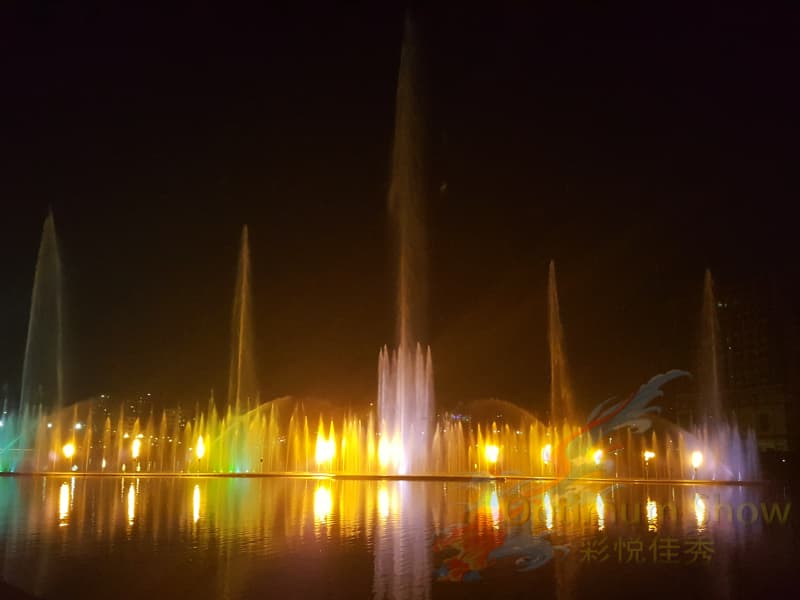
A fountain's hardware determines what it can do. Choreography determines whether anyone will stop to watch.
Two fountains with identical equipment — the same pumps, the same nozzles, the same control system — can produce completely different results depending on how their shows are programmed. One will pulse mechanically on the beat, predictable after thirty seconds. The other will feel like the water is listening to the music, rising and falling with the melody, pausing at the right moment, building toward a release that makes people turn and look.
That difference is choreography — and it is the single most important factor in whether a musical fountain becomes a destination or fades into the background.
This article explains how professional fountain choreography is created, from the first analysis of a music track through to the techniques that separate a memorable water show from one that nobody watches twice. For a detailed explanation of the control systems and hardware that execute these decisions, see our guide to How Musical Fountains Work.
Fountain choreography is the process of translating the structure and emotion of music into precisely timed sequences of water movement, lighting colour, and visual composition. It is the creative and technical layer that sits between the control system and the audience.

This distinction is worth making clearly, because the two are often conflated.
Programming is the technical execution — configuring the control software, assigning DMX addresses, setting valve timings, and ensuring the system responds correctly to commands. It is a precise, largely engineering-driven task.
Choreography is the creative decision-making that determines what those commands should be and when they should happen. It requires musical understanding, visual judgement, and an instinct for pacing and emotional arc. A choreographer might also be the programmer, but the skills are distinct.
A simple way to think about it is orchestration. In music, different instruments play different roles—some carry the melody, others build intensity or rhythm. In a fountain, nozzle groups act like instruments, jet heights create emphasis, and lighting sets the mood. Everything must be timed and layered with intent.
Without choreography, even advanced systems produce shows that feel random. With it, the fountain becomes a coherent performance—structured, expressive, and memorable.
Before any fountain effects are programmed, the music is analysed in detail. This stage defines the structure, timing, and emotional direction of the entire show—effectively serving as the blueprint for musical fountain choreography.
Structural Mapping
The track is first divided into key sections—intro, verse, chorus, bridge, and outro—with each segment labelled by its energy level and mood. A high-energy chorus requires a very different treatment from a soft bridge, even at the same tempo. This structure guides how intensity, water height, and visual pacing evolve throughout the show.
Beat and Rhythm Analysis
Next, choreographers identify timing anchors such as downbeats, bar lines, and rhythmic accents. These act as reference points for synchronization. While basic programming triggers effects directly on beats, advanced choreography uses rhythm more flexibly—layering movements between beats for smoother and more dynamic transitions.
Melody Interpretation
This is where professional choreography stands apart. Instead of following rhythm alone, experienced designers map melodic movement to water behaviour. For example:
This creates a performance that feels expressive and fluid, rather than mechanical.
Genre-Based Choreography Strategy
Different music genres require different choreography approaches:
By combining structure, rhythm, melody, and genre interpretation, choreographers ensure that the water doesn’t just follow the music—it performs it.
Designing a musical fountain choreography is a structured process that blends creative direction with technical precision. Each stage builds on the previous one, turning a music track into a synchronized water performance.

The process begins with annotating the music track inside the control software.
Choreographers place markers at key moments, including:
A typical five-minute track can generate hundreds of timing markers before any water effects are added.
This step creates the timeline foundation for the entire show.
Once the music is mapped, the next step is to assign musical roles to different nozzle groups.
Specific water effects are matched to specific moments in the soundtrack. The core principle here is the same as in musical orchestration: contrast. Not every moment should feel equally intense.
A fountain show that uses its biggest effects all the way through quickly becomes visually exhausting. Strong choreography holds back, builds momentum, and saves the most dramatic moments for when the music truly supports them.
Lighting design is developed in parallel with water choreography, not added afterward.
Colours are aligned with the emotional tone of the music:
Transitions are typically smooth and gradual, unless sharp changes are required to match musical accents.
Lighting also affects how water is perceived. A jet illuminated with strong contrast appears taller, sharper, and more dramatic than the same jet under neutral lighting. Effective lighting enhances the choreography rather than competing with it.
Before the show reaches the physical fountain, it is usually tested in simulation software, most commonly Depence by Syncronorm.
This stage helps identify timing conflicts, spacing issues, and compositional problems early. It also gives clients a way to review the show before on-site commissioning begins.
In practical terms, simulation reduces friction later. It saves time, improves communication, and helps prevent costly revisions during installation.
Even the best simulation cannot predict everything perfectly.
Real-world conditions always introduce variables. Jet heights may respond differently under actual pump load. Wind can alter laminar arcs. Some sequences that look balanced on screen may feel crowded or weak when viewed in person.
This is why commissioning matters so much. The show is run repeatedly, adjusted, tested, and refined until the live performance matches the intended effect.
This final stage is where a show moves beyond being technically correct and becomes genuinely impressive.
If you want, I can also make this section feel even more editorial and premium, so it matches a stronger Optimum Show blog tone.
Different fountain nozzle types offer distinct visual effects, and selecting the right one for each moment is a core part of musical fountain choreography. Each nozzle has specific strengths and limitations, and understanding these directly shapes how water is used to interpret music.

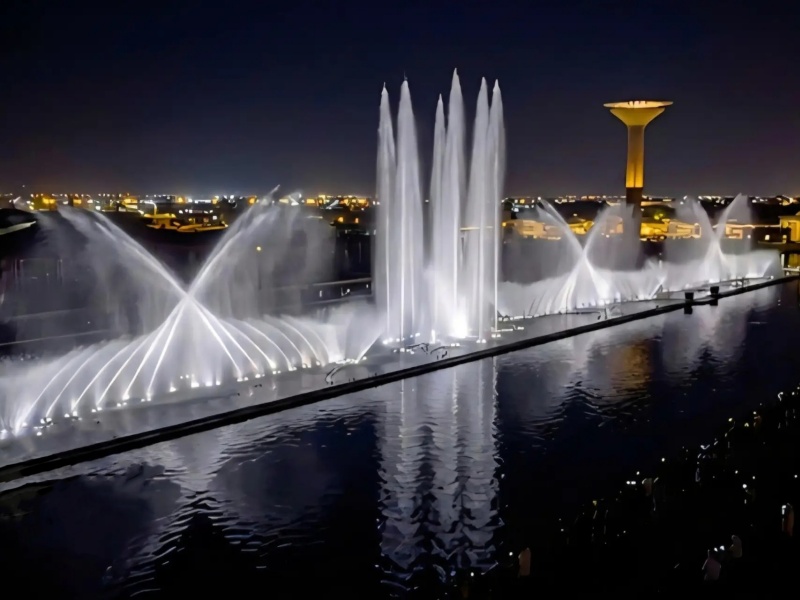
Laminar jets produce smooth, glass-like arcs with highly controlled trajectories. They are ideal for melodic passages where clarity and precision matter.
Their clean lines make them especially effective for crossing patterns and symmetrical compositions, often used to reflect refined or lyrical sections of music.
Geyser and plume jets create strong vertical columns of water, delivering maximum visual impact.
They are best used during climaxes, bass hits, and dramatic transitions. Because they require significant pump capacity, they should be used strategically at peak moments, not continuously.
Swing jets introduce lateral motion, creating sweeping or pendulum-like effects.
They are highly effective for rhythmic sections, transitions, and call-and-response patterns, helping translate musical movement into spatial motion.
Fan-shaped nozzles and curtain effects produce wide, horizontal water spreads.
These are typically used as background layers, supporting the overall composition rather than acting as focal points. They help define structure and provide visual continuity across different sections of a show.
Foam jets and mist systems generate soft, diffuse water forms.
They are suited for intros, quiet passages, and atmospheric moments where sharper effects would feel out of place. They also create strong contrast when transitioning from high-energy sequences.
The underlying rule: every effect should earn its moment.
High-quality musical fountain choreography relies on a set of core techniques that remain consistent regardless of music style, project scale, or fountain type. These techniques form the foundation of how water dance with music is translated into a coherent visual performance.
Chase effects send the same movement sequentially across a row or ring of jets, creating a wave-like progression across the fountain surface.
When aligned with rhythm, they make the fountain appear to breathe or ripple with the music, and are particularly effective for:
Build and release is the central structural technique in fountain show choreography.
Energy accumulates across multiple bars:
This leads to a defined peak moment, followed by a controlled release.
The release is equally important. A sudden drop to a single jet or soft lighting wash allows the audience to process the climax, making the next sequence more impactful.
Mirror symmetry uses bilateral or radial patterns to create visual balance within the fountain layout.
It is particularly effective in:
Symmetry creates a sense of order, structure, and completeness, which helps audiences intuitively understand complex water movements.
Height dynamics treat jet height as a continuous expressive parameter rather than a simple on/off effect.
Typical techniques include:
When synchronized correctly, height variation becomes one of the most emotionally readable elements of a water show.
Silence moments are one of the most underused — and most powerful — techniques in professional musical fountain choreography.
When the music pauses, the instinct is often to fill the gap with movement. However, experienced choreographers do the opposite:
This restraint creates anticipation and significantly increases the impact of the next musical and visual entry.
In practice, what you don’t show is as important as what you do
Not all musical fountain choreography follows the same approach. In practice, professional designers develop water dance with music sequences using several distinct choreography styles, each suited to different project goals, locations, and audience expectations.

This style maps fountain effects directly to the beat structure of the music. It is the most immediately readable form of water dance with music, making it highly effective for contemporary, electronic, and high-energy tracks where rhythm is dominant.
However, over-reliance on beat matching can make a show feel mechanical. The strongest rhythm-based choreography introduces variation by responding not only to beats, but also to musical phrasing and dynamics.
Instead of reacting to individual beats, this approach structures the fountain show as a complete narrative. Water, lighting, and music are choreographed to follow a clear arc — introduction, development, climax, and resolution.
This style is commonly used in:
It is particularly effective with cinematic and orchestral music, where emotional progression is more important than rhythmic precision.
Interactive choreography introduces real-time variability, allowing audience movement or participation to influence fountain behavior. This is most often seen in dry deck fountains and public plazas, where engagement is a priority.
Unlike fixed musical fountain choreography, this style requires designing for:
It is especially valuable for daytime operation, where the goal is to attract and engage passers-by rather than deliver a scheduled performance.
This style prioritizes scale, intensity, and visual impact over subtle musical interpretation. It typically combines:
High-impact choreography is designed for:
The focus is on creating memorable peak moments that generate strong audience reactions and social sharing.
In most commercial projects, the most effective strategy is not choosing a single style, but combining several.
A typical programming approach may include:
Rotating these programs helps maintain visitor interest while ensuring the fountain remains relevant across different times of day and usage scenarios.
Even with advanced control systems, achieving precise water dance with music is constrained by real-world physical and environmental factors. These limitations are not flaws — they are fundamental conditions that must be designed into the choreography from the beginning.
Synchronisation delays are among the most technically demanding aspects. Water does not respond instantly — there is always latency between a command and a jet reaching its intended height. This delay varies depending on pump load, pipe length, and valve type. Professional choreography compensates for this by building timing offsets into the show, triggering commands slightly ahead of the musical moment. Even minor misalignment is immediately visible, making timing accuracy critical.
Environmental conditions introduce another layer of complexity. Wind distorts jet trajectories, reduces effective height, and disrupts fine effects such as laminar arcs. While modern systems use wind sensors to automatically reduce output, choreography for outdoor fountains is typically designed around realistic operating conditions, not perfect weather. The goal is consistency, not peak performance under ideal circumstances.
Hardware response limits further shape what is achievable. Pumps cannot change output instantaneously due to inertia, and valve response times vary across systems. These constraints define the boundaries of the choreography. Experienced designers work within them from the outset, rather than attempting effects that the system cannot reliably deliver.
A less obvious challenge is long-term content fatigue. A fountain that runs the same limited set of shows over time will gradually lose its impact. Maintaining engagement requires ongoing updates to choreography, whether through new sequences or periodic refreshes. This introduces operational considerations that should be planned from the beginning, not after installation.
One five-minute show, programmed to a professional standard, typically takes one to two weeks — music analysis, effect mapping, lighting, simulation, on-site refinement. Larger multi-zone installations take more. This needs to be an explicit line item in the project schedule, not absorbed into general commissioning.
Most commercial fountains carry five to twelve active shows. For markets with significant cultural events — national days, Ramadan, major festivals — building seasonal shows into the initial scope is substantially cheaper than commissioning them later. It's one of those decisions that's easy to defer and expensive to regret.

At Optimum Show, choreography is treated as a deliverable in its own right, not a post-installation task. Our choreography service begins during the design phase, when nozzle placement and hydraulic layout decisions are still being made — because the best choreography is only possible when the equipment has been configured to support it.
This means that show intent shapes hardware decisions from the start. If a show requires rapid laminar arc transitions, the valve and pump specifications need to support that response time. If a thematic show requires a specific height profile at a specific musical moment, the hydraulic design needs to deliver it reliably. Treating choreography as an afterthought consistently results in shows that underperform the equipment's potential.
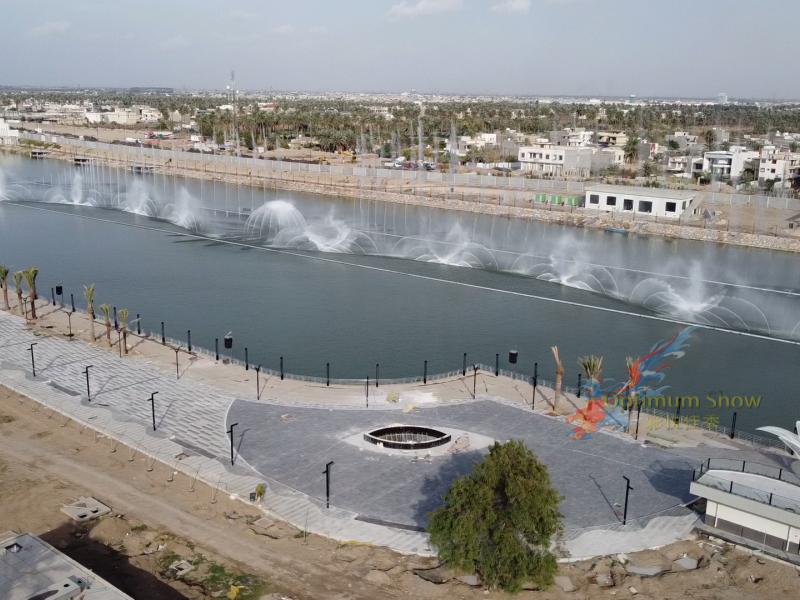
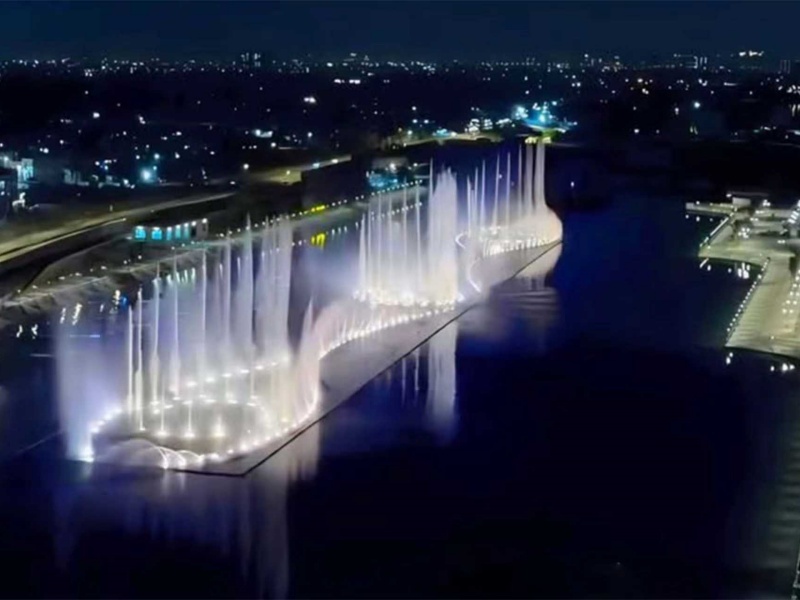
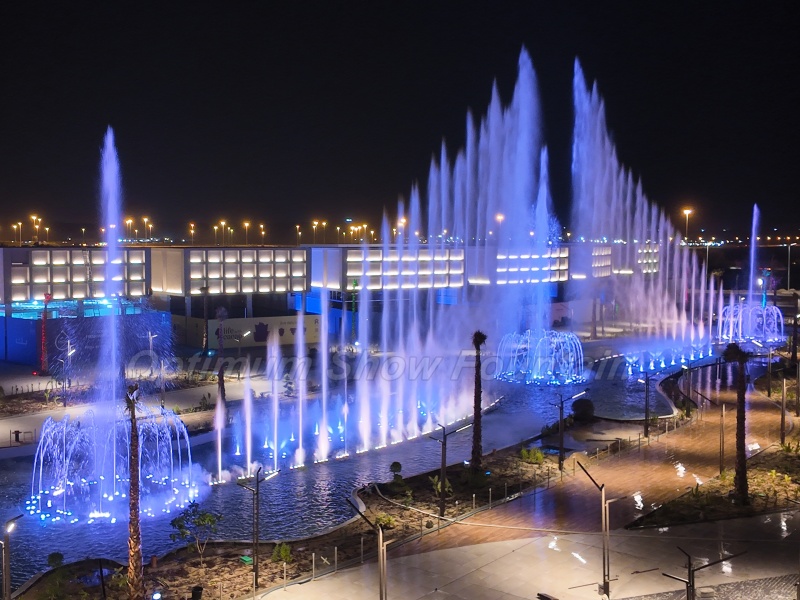
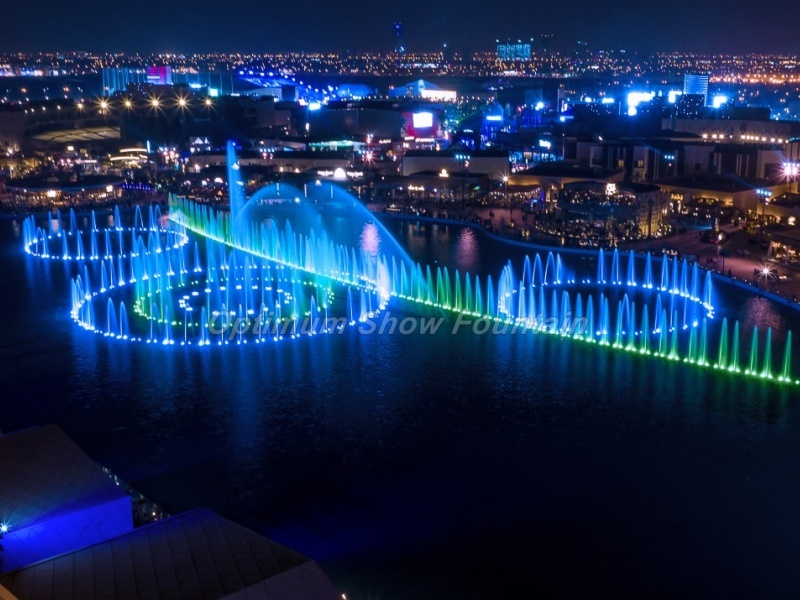
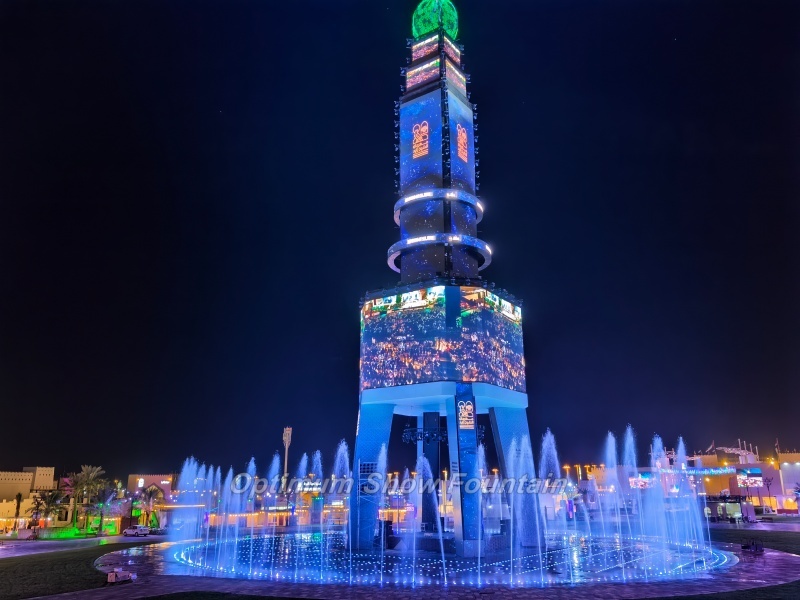
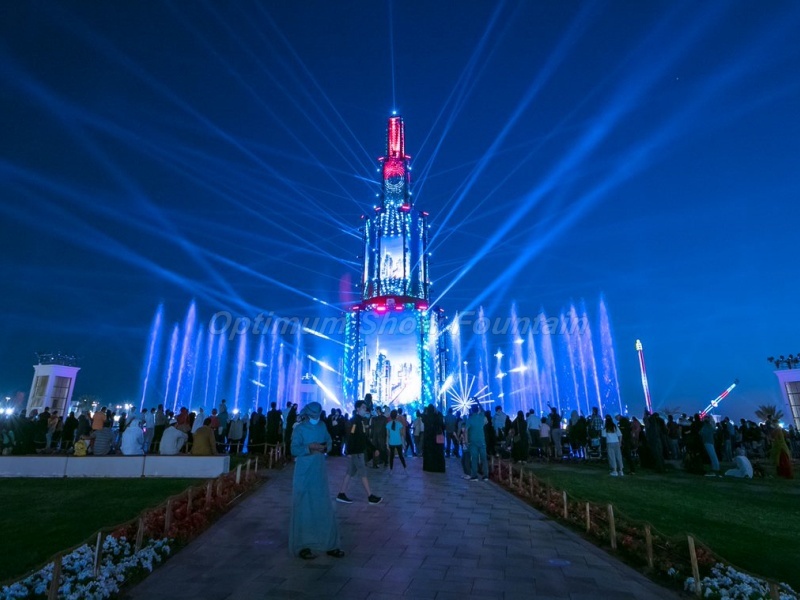
Projects including the Sheikh Zayed Festival fountain and the Baghdad Island installation reflect this integrated approach. In both cases, the shows these fountains run were considered from the first design drawing, with choreographic requirements feeding directly into hydraulic and lighting specifications.
If you are planning a musical fountain and want to discuss how choreography requirements should shape the system design, contact our team to arrange a consultation.
A musical fountain is synchronised using a central control system with time-coded programming. The system sends precise commands to pumps, valves, and lights based on the music timeline. Latency is calibrated so water movement and lighting effects match the beat in real time.
The most common software is Depence by Syncronorm, which combines 3D simulation with timeline-based programming. It allows designers to create, test, and adjust fountain shows before installation. Some musical fountain manufacturers also use proprietary software integrated with their fountain control systems.
Programming a professional musical fountain show typically takes 1 to 2 weeks for a 3–5 minute sequence. This includes music analysis, choreography design, programming, simulation, and on-site adjustments. Larger or more complex fountain systems may require additional time.
Yes, musical fountain choreography can be updated without changing hardware. New shows are created in software and uploaded to the control system. Most projects refresh their fountain shows every 1–2 years, with seasonal or event-based updates added in between.
Water movement is controlled by a combination of pumps, solenoid valves, and variable frequency drives (VFDs). These components are managed by the fountain control system, which adjusts pressure, flow, and timing to create synchronized water effects.
The hardware defines what a fountain can do. Choreography is why people watch it.
Show quality isn't about jet count or maximum height. It's about whether the water, light, and music have been assembled into something that holds attention, builds emotion, and gives people a specific feeling when it ends. That takes musical understanding, compositional thinking, technical precision — and the kind of judgment that only comes from doing it repeatedly. Knowing when to hold back. Knowing when a single jet in still water carries more weight than twenty running at full height.
For project owners: plan choreography from the beginning, not at the end. The best results come from systems where hardware decisions and creative intent develop together — not from systems where the show was an afterthought.
Share your site size, water depth, location or CAD drawing with our engineering team. We can evaluate the project requirements and recommend a suitable fountain system.