Digital water curtain systems utilize programmable jets and solenoid valves to craft intricate patterns and text. Synchronized with advanced software, these systems integrate music and lighting for a heightened sensory experience. Ideal for high-traffic areas and events, they offer dynamic visual appeal. However, strategic placement and environmental considerations are essential. Yet, is this technology always the best choice? Exploring its design considerations and operational demands may reveal unexpected insights.

A digital water curtain is a programmable water feature that uses precisely controlled streams of falling water to display text, patterns, logos, and simple animations in mid-air. Instead of acting purely as decoration, it functions as a dynamic visual display system—often described as a “water printer.”
At the top of the system, a row of electronically controlled solenoid valves rapidly opens and closes to release water in timed intervals. Each stream of water acts like a pixel, and by controlling when each stream turns on or off, the system forms recognizable shapes as the water falls. These patterns can be updated in real time through software, allowing for flexible content such as branding messages, event visuals, or interactive effects.
Most digital water curtains operate using a closed-loop water system, where water is collected, filtered, and recirculated continuously. Many installations also integrate LED lighting, which enhances visibility and allows the display to stand out in different lighting conditions, especially at night.
In practical terms, a digital water curtain sits between a traditional fountain and a digital screen—it combines physical movement, programmable control, and visual communication to create a unique, attention-grabbing feature in commercial and public spaces.
At first glance, a digital water curtain looks complex — text, patterns, even animations appearing out of falling water.
In reality, the underlying principle is surprisingly simple.
You can think of it as a precision-controlled water printer.
At the top of the installation sits a stainless steel manifold fitted with a high density of nozzles — typically around 32 nozzles per linear metre.
Each nozzle is connected to a fast-response solenoid valve, controlled by dedicated software.
Here’s where the “magic” happens:
These on/off moments create gaps and streams in the falling water.
As the water falls, the pattern continuously scrolls downward — which is why all digital water curtain visuals are inherently animated, constantly refreshing frame by frame under gravity.
Each droplet effectively acts as a pixel, and the entire curtain becomes a dynamic, vertical display.
Despite the visual complexity, the water system itself is highly efficient.
Water is collected in a basin at the bottom and recirculated in a closed loop:
Water is added only during commissioning, with minor top-ups over time to compensate for evaporation.
To maintain stable performance, filtration systems remove impurities and prevent nozzle clogging — a small detail, but critical for long-term reliability.
A digital water curtain is not just about water — it’s a fully integrated media system.
Most installations include RGB LED lighting mounted alongside the nozzles and controlled via the DMX512 protocol.
This allows lighting and water to be perfectly synchronized:
Everything can be programmed as one unified show.
Modern systems go far beyond simple patterns. Depending on the project, a digital water curtain can integrate with multiple control layers:
These capabilities turn the installation from a decorative feature into a programmable architectural media display.
Digital water curtains are not a single standardized product. In practice, different configurations are selected based on space geometry, viewing direction, and the level of visual impact required.
While the underlying technology remains consistent, the way the system is arranged in space significantly changes how it performs — and where it should be used.

The linear format is the most widely used configuration, built from modular sections that can be extended to almost any width. When properly installed, the joints between modules are visually seamless, creating a continuous water surface.
Its main advantage lies in flexibility. The same system can function as a permanent architectural feature or be deployed temporarily for events, since modular units can be assembled and dismantled relatively quickly. Because the display is flat and directional, it performs best in spaces where people approach from a defined viewing angle, allowing patterns and text to remain clear and legible.
Best suited to: hotel lobby entrances, retail display walls, stage backdrops, atrium dividers, airport hall features — especially where a clean, front-facing display surface is needed.
Curved water curtains are developed from the same modular systems as linear installations, but arranged along a concave or convex arc. The key challenge is maintaining consistent flow and spacing across the curve so that the water surface appears uniform rather than uneven.
This format is typically selected when the surrounding architecture is not linear. In spaces defined by curves — such as circular atriums or wrap-around layouts — a straight installation can feel visually disconnected. A curved curtain, by contrast, follows the geometry of the space and integrates more naturally into the overall design language.
Best suited to: curved architectural features, wrap-around atriums, concave entrance canopies, and spaces where alignment with surrounding geometry is more important than simplicity.
Circular configurations form a full or partial ring, creating a cylindrical curtain of falling water that can be viewed from multiple directions. Unlike flat installations, which are typically experienced from one side, circular formats invite movement around the feature and engagement from all angles.
This changes how people interact with the installation. Instead of passing by, visitors tend to pause, circle, and observe from different perspectives. For this reason, circular water curtains are often positioned as central features in open spaces rather than as background elements.
Best suited to: atrium centerpieces, public plazas, exhibition halls, and high-traffic indoor environments where 360-degree visibility and sustained attention are important.
3D water curtain systems extend beyond a single plane, creating volumetric displays by layering water streams or controlling droplets in three-dimensional space. The result is a form that appears to have depth, rather than a flat surface.
This format is typically chosen for projects where the installation itself is intended to be the main attraction. Compared to linear or curved systems, it offers significantly greater visual impact and creative flexibility, but also requires more space, structural support, and system complexity.
Best suited to: large-scale public landmarks, theme parks, major commercial developments, and high-profile hospitality projects where the installation is designed as a destination feature.
Not every project benefits from a digital water curtain. In many cases, a static water feature or a screen-based solution is sufficient.
The difference comes down to one question:
Does the installation need to display content, adapt over time, or respond to people?
In environments where the answer is yes, digital water curtains tend to offer advantages that simpler solutions cannot match.

In hotel environments, the requirement goes beyond first impressions. The visual identity of the space often needs to adapt — across seasons, events, and different types of guests.
A digital water curtain allows this flexibility without changing the physical installation. Content such as branding, welcome messages, or event-specific visuals can be updated through software, rather than through physical signage or temporary structures.
This becomes particularly relevant in properties that host conferences or events. The same installation can present different identities throughout the day, shifting from ambient display to event-specific messaging without any reconfiguration of the space.
In retail settings, attention is limited and highly competitive. The challenge is not just to be seen, but to make people stop.
Digital water curtains — especially interactive or walk-through configurations — tend to create that pause. People engage with the installation, observe it, and often return with others. This type of behavior is harder to achieve with conventional water features or standard digital displays.
At the same time, the display surface can serve a functional role. During operating hours, it can carry promotional or branded content; outside peak times, it can revert to a more ambient visual mode. This dual use allows a single installation to support both experience and communication.
In corporate environments, there is often a balance to strike between branding and spatial clarity.
Traditional approaches rely on screens or signage, which can feel visually intrusive. A digital water curtain offers an alternative: branding can be presented in a more integrated and less rigid form, using motion, light, and material rather than fixed panels.
For conference centres, flexibility is equally important. Different events require different identities, and a reprogrammable display reduces the need for temporary branding installations. The system becomes part of the space, rather than an addition to it.
In public-facing environments, long-term engagement becomes a key consideration.
Many installations attract attention initially but gradually fade into the background as people become familiar with them. Digital water curtains address this by allowing the content to evolve — visually refreshed over time without changing the physical structure.
The interactive dimension also plays a role here. Installations that respond to movement or allow people to pass through create a different type of engagement — one that is intuitive and does not require explanation. This is particularly effective in environments designed for exploration, such as museums or themed destinations.
For temporary use, the decision is less about permanence and more about impact.
Digital water curtains are not typically chosen for cost efficiency. Instead, they are used in situations where creating a strong visual moment matters — product launches, exhibitions, or stage environments where differentiation is important.
In practice, these systems are often deployed on a temporary basis rather than purchased outright. Modular construction allows relatively fast installation and removal, making them suitable for short-term use across multiple venues.
This combination — high visual impact with temporary deployment — is what makes them a recurring choice in event contexts.
Why might one reconsider the implementation of a digital water curtain? In environments characterized by high wind conditions, digital water curtains may lose pattern clarity, as wind can disrupt water droplets, leading to distorted displays.
Projects requiring long-distance viewing may also face challenges; the intricate patterns created by the water jets might not be discernible from afar.
Additionally, locations demanding low maintenance and constant uptime are not ideal for digital water curtains. These systems require regular upkeep to maintain peak performance, including water quality management and nozzle maintenance.
Consequently, installations that cannot support frequent maintenance intervals or need uninterrupted operation without supervision should explore alternative solutions. Such considerations guarantee that the technology aligns with the project's logistical and environmental constraints.
One of the most common points of confusion at the early specification stage is the difference between three visually similar — but fundamentally different — water-based display systems: digital water curtains, static water walls, and water screen projection.
They may look comparable at a glance, but they are designed for completely different purposes. Choosing the wrong one often means either paying for capabilities you don’t actually need, or failing to achieve the intended visual effect.
A simple way to understand the difference is to compare what each system is actually capable of:
| Indoor/architectural | Digital Water Curtain | Static Water Wall | Water Screen Projection |
| Displays dynamic content | ✅ Text, logos, animation | ❌ Decorative only | ✅ Full-motion video |
| Interactive capability | ✅ Sensors, touch, walk-through | ❌ None | ⚠️ Limited |
| Best environment | Indoor + outdoor (properly specified) | Indoor / architectural | Outdoor, low-light only |
| Installation type | Permanent or temporary | Permanent | Temporary or semi-permanent |
| Daytime visibility | ✅ Fully visible | ✅ Always visible | ❌ Requires darkness |
| Physical water presence | ✅ Direct interaction | ✅ Visual + ambient | ❌ Projection only |
| Relative cost | Medium to high | Low to medium | Medium (incl. projection system) |
The table highlights a key distinction: these systems are not interchangeable — they are designed around different priorities.
A digital water curtain is typically selected when a project needs both programmable visual content and the physical presence of real water. It is especially relevant in commercial environments where branding, interactivity, or content flexibility are required, and where a purely decorative feature would not be sufficient.
A static water wall, by contrast, serves a much simpler role. It provides texture, movement, and ambient sound, but does not carry information or change over time. This makes it a more appropriate choice in architectural settings where the water feature is intended to support the space rather than define it — and where lower cost and minimal operational complexity are priorities.
Water screen projection sits in a different category altogether. It is primarily used when the goal is to display full-motion video at large scale, something that no droplet-based system can replicate. However, this comes with clear constraints: it requires controlled lighting conditions, typically performs best at night, and removes the possibility of physical interaction with the water itself.
In practical terms, the decision is not about which system is “better”, but about what the project actually needs to achieve —
whether that is atmosphere, communication, or spectacle.
A digital water curtain may look straightforward in concept, but the final visual result depends heavily on how well a few key design factors are handled.
Most performance issues in real projects — unclear text, distorted patterns, or weak visual impact — are not caused by the system itself, but by decisions made at the design stage.

One of the most common issues is simple: the content looks clear up close, but becomes unreadable from where people actually stand.
Digital water curtains do not behave like LED screens. Their effective “resolution” is limited by nozzle density, which means viewing distance must be considered early in the design.
If the audience is too far away:
In practice, this means the installation should be designed around real viewing positions, not ideal ones. Projects that require readable text at close range often need higher nozzle density, while installations viewed from a distance should prioritize bold, simplified graphics.
For outdoor installations, wind is not a minor factor — it directly affects whether the display works as intended.
Even moderate airflow can disrupt the trajectory of falling water, breaking patterns and making text unreadable. In exposed environments, this can reduce a precise digital display to something visually inconsistent.
To address this, projects typically rely on:
Ignoring wind conditions at the planning stage is one of the most common reasons outdoor installations fail to deliver expected results.
Lighting determines whether the display is visible or not.
In strong daylight, subtle patterns and fine details can easily be washed out, especially if no additional shading or contrast is introduced. At night, the situation reverses: integrated lighting can significantly enhance the visual effect, making the display far more dramatic.
Because of this, lighting should not be treated as an add-on. It needs to be considered together with the water display itself, particularly in projects where the installation is expected to perform both day and night.
A digital water curtain rarely exists in isolation. Its impact depends largely on how well it fits within the surrounding space.
Placement affects everything:
Beyond visual alignment, there are also practical requirements — water supply, drainage, maintenance access — that need to be resolved early in the design process.
Well-integrated installations feel intentional and effortless. Poorly integrated ones, even with advanced technology, often feel out of place.

Cost is usually the first question clients ask — and the one most articles avoid answering clearly.
The reason is simple: there is no fixed price.
Digital water curtains are engineered systems, and total cost depends on scale, environment, and level of customization.
However, there are still useful ways to understand what a typical project involves and where the budget actually goes.
In commercial projects, digital water curtains are usually priced based on system width, configuration, and installation requirements rather than as a fixed product.
In practical terms, most projects fall into three broad categories:
1. Standard indoor installations (mid-scale)
This is the most common category, typically used in hotel lobbies, retail environments, and indoor public spaces. These projects focus on clean integration, stable operation, and moderate visual impact.
2. Large-scale or outdoor installations
Projects at this level involve additional engineering — larger basins, weather protection, structural work, and often more complex formats such as curved or multi-layer displays. These are usually landmark features rather than decorative elements.
3. Temporary or event-based systems
Smaller systems designed for short-term use. In many cases, these are rented rather than purchased, especially for one-off events or touring applications.
Rather than a single price point, it is more accurate to think in terms of project scale and complexity.
Once the project type is defined, cost is largely determined by a few key factors.
Physical scale: Wider installations require more modules, more nozzles, and larger pumping capacity. Increased height also affects system design, particularly basin size and water handling.
Environment: Outdoor systems require weather protection, wind management, and more robust structural support. These are not optional upgrades — they are necessary to ensure the system performs reliably.
Interactivity and control: Basic systems run pre-programmed sequences, while more advanced installations may include motion sensors, real-time content updates, or multi-zone control. Each additional layer introduces both hardware and programming requirements.
Integration complexity: Projects that involve synchronization with lighting, music, or other media systems require additional commissioning and coordination.
Custom formats: Such as curved, circular, or 3D configurations — typically involve more engineering work than standard linear installations, which is reflected in both lead time and budget.
Beyond the initial installation, ongoing costs are relatively modest.
Digital water curtains operate on a closed-loop system, so water consumption is minimal — limited mainly to evaporation. Electrical usage typically covers pumps, lighting, and control systems, which is moderate compared to the visual impact delivered.
Maintenance is generally straightforward:
When properly specified and maintained, a system can operate reliably for years without major replacement costs.
Every digital water curtain project is unique. Optimum Show provides project-specific quotations based on your space dimensions, specification requirements, and integration needs — no generic price lists.
→ Contact Optimum Show for a Digital Water Curtain Quote
In the operational reality of digital water curtain systems, regular valve maintenance is critical to prevent malfunctions and guarantee precise water flow.
Effective water quality management is essential, as impurities can obstruct nozzles and degrade system performance.
Reliability hinges on a robust maintenance routine, integrating both mechanical checks and water treatment protocols to maintain peak functionality.

Guaranteeing ideal functionality of digital water curtain systems hinges greatly on meticulous valve maintenance. Solenoid valves, integral to controlling water jets, require regular inspection and cleaning to prevent blockages and guarantee responsive operation.
Without proper maintenance, valve failures can lead to uneven water flows and reduced system efficiency. Regularly scheduled maintenance not only prolongs the lifespan of the system but also enhances performance reliability.
These practices are essential for sustaining the innovative features of digital water curtains, maintaining their aesthetic appeal and functional integrity. Proper valve maintenance is a cornerstone of operational excellence.
Valve maintenance markedly impacts the overall functionality of digital water curtain systems, directly influencing water quality management.
Effective water quality management relies on the integration of sophisticated filtration systems designed to remove impurities that could clog the nozzles and impair performance. Regular monitoring and maintenance of these filters are essential to preventing the buildup of debris and guaranteeing consistent water flow.
Advanced water treatment technologies, akin to those used in aquatic facilities, enhance the purity and clarity of the water, guaranteeing optimal operational conditions.
Additionally, submersible pumps equipped with special filters are integral to maintaining system efficiency. These measures collectively guarantee the system's longevity, minimizing downtime and maximizing display precision, vital for maintaining audience engagement and system reliability.
System reliability pivots on meticulous maintenance and operational precision, guaranteeing digital water curtain systems function efficiently.
Regular inspections of the manifold, nozzles, and solenoid valves are essential to prevent malfunctions and maintain peak performance. The integration of advanced diagnostics aids in early detection of potential issues, minimizing downtime.
A robust filtration system is imperative to prevent clogs and guarantee smooth water flow.
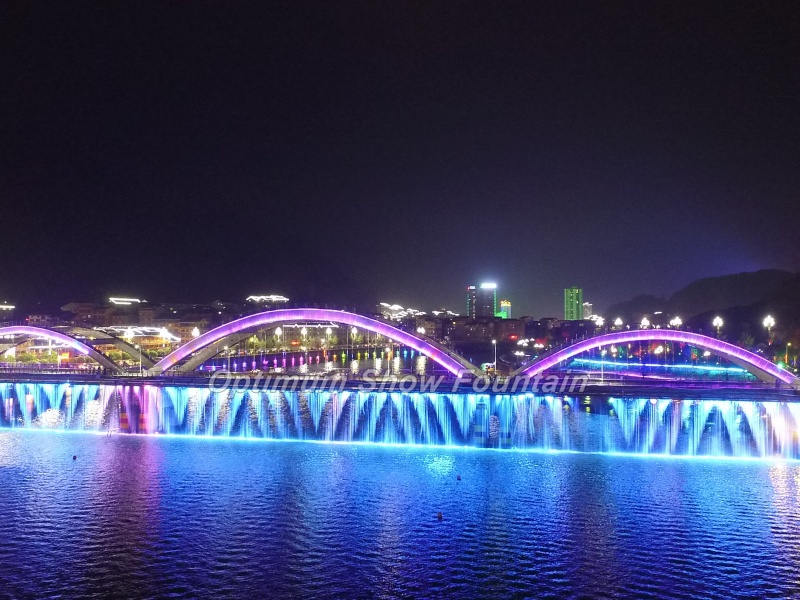
Optimum Show is a direct manufacturer of digital water curtains and musical fountain systems, based in Guangzhou with project experience across Asia, the Middle East, and global markets. The company supports projects through the entire lifecycle—from concept design and 3D visualisation to engineering, manufacturing, installation, choreography programming, and ongoing maintenance.
This end-to-end approach is particularly important for digital water curtain systems, which combine civil engineering, electronics, control software, and visual performance design. When different parts of the project are handled by separate suppliers, coordination gaps can lead to delays, performance issues, or inconsistent results. A full-lifecycle manufacturer helps reduce these risks and ensures the system works as intended from day one.
Optimum Show’s experience includes large-scale and technically complex installations, such as:
For each project, Optimum Show provides:
Whether you are exploring a concept or planning a specific installation, Optimum Show can assist with technical consultation, reference projects, and tailored solutions.
→ Contact Optimum Show for digital water curtain enquiries
Digital water curtains can indeed operate in cold climates, contingent on thorough controls and careful considerations. Continuous circulation curtails freezing, while insulated installations and innovative heating solutions safeguard system stability, ensuring seamless spectacle and sustained operation in sub-zero settings.
Yes — displaying logos, brand names, custom graphics, and animated content is one of the primary commercial applications. Content is programmed via the control software and can be updated without any physical changes to the installation. Multiple programmes can be stored and switched on a schedule — for example, welcome messaging during the day and ambient pattern display in the evening.
Installation typically takes several days to a few weeks, depending on complexity. The intricate process unfolds meticulously, with precision engineering and careful calibration ensuring each nozzle aligns perfectly, promising a mesmerizing display and innovative spectacle upon completion.
A digital water curtain system typically has a lifespan of 10-15 years. This duration depends on regular maintenance, water quality management, and system component care, ensuring peak performance and longevity in innovative architectural or event settings.
Coincidentally, as technology advances, digital water curtain systems can indeed be customized for specific cultural themes. Programmable features allow intricate designs reflecting cultural symbols or texts, offering dynamic, immersive experiences tailored to diverse cultural contexts.
A digital water curtain offers something unique: dynamic, programmable visuals created with real falling water—not screens or projections. This makes it especially effective for spaces where the goal is to create a memorable, interactive experience, such as hotel entrances, public landmarks, or branded events.
It does require more planning, engineering, and investment than a standard water feature, but for projects focused on impact and engagement, few alternatives deliver the same result.
Next steps: define your key parameters (size, location, indoor/outdoor, power), decide between permanent or temporary installation, and consult with an experienced manufacturer to assess feasibility and budget.
Optimum Show supports digital water curtain projects from concept to installation worldwide. Get in touch to discuss your project.
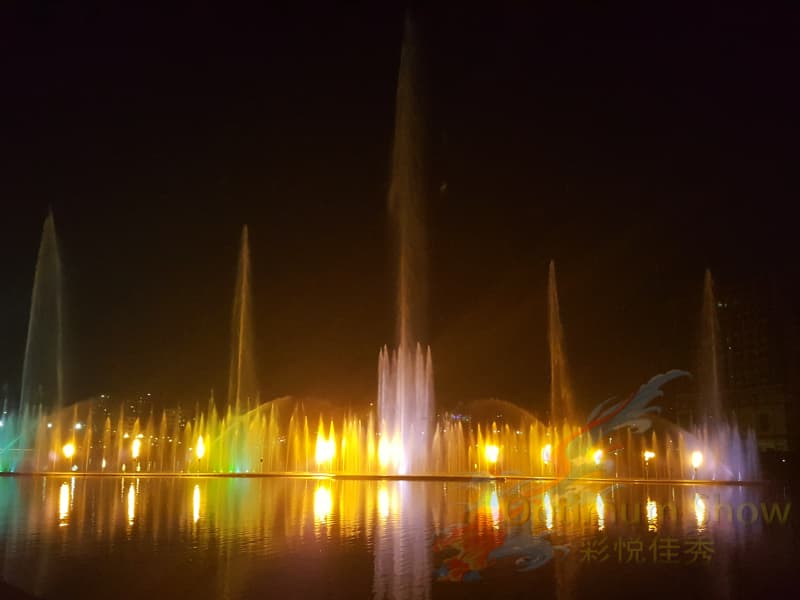
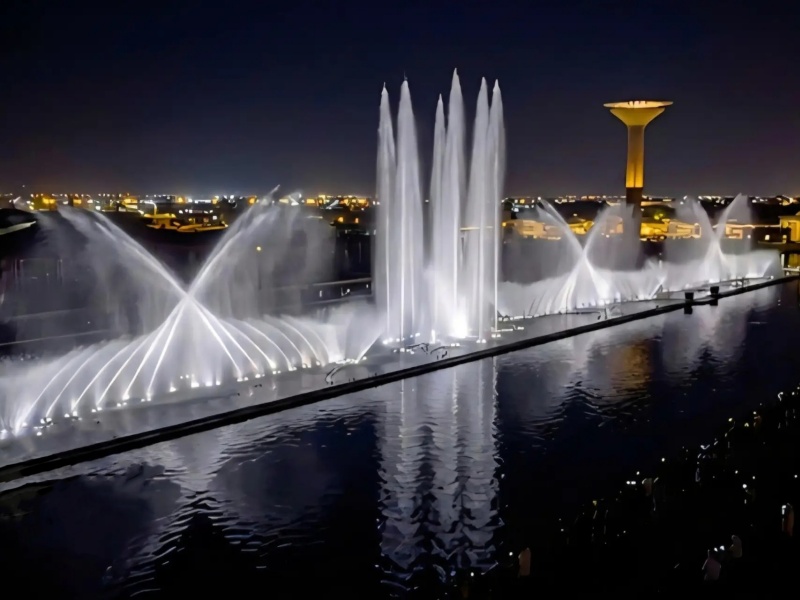
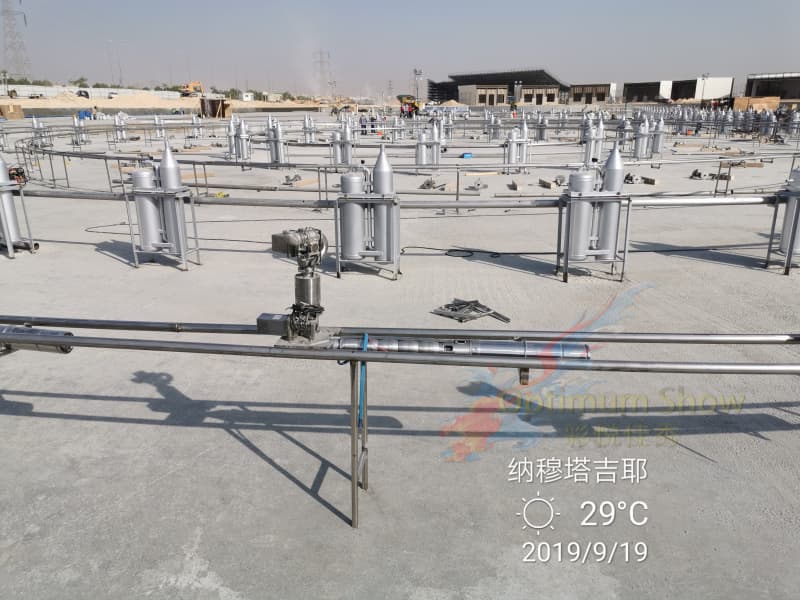
Share your site size, water depth, location or CAD drawing with our engineering team. We can evaluate the project requirements and recommend a suitable fountain system.