Building a fountain show follows a structured process, whether the project is for a hotel, city plaza, commercial development, or large natural lake. If you're wondering how to build a fountain show, the process typically includes site assessment, structural planning, equipment engineering, control system design, installation, commissioning, and final handover. While the budget, technology, and project scale may differ, the overall workflow remains consistent.
This guide explains each stage in the order a fountain show project is actually built—from concept and site evaluation to opening night and ongoing operation.
Every fountain show starts with a clear answer to one question: what is this fountain supposed to do? A landmark fountain built to anchor a city plaza has different requirements than one designed to entertain hotel guests each evening or a display built for a single event. Define the purpose first, because it shapes every decision that follows, including nozzle count, show length, and control system complexity.
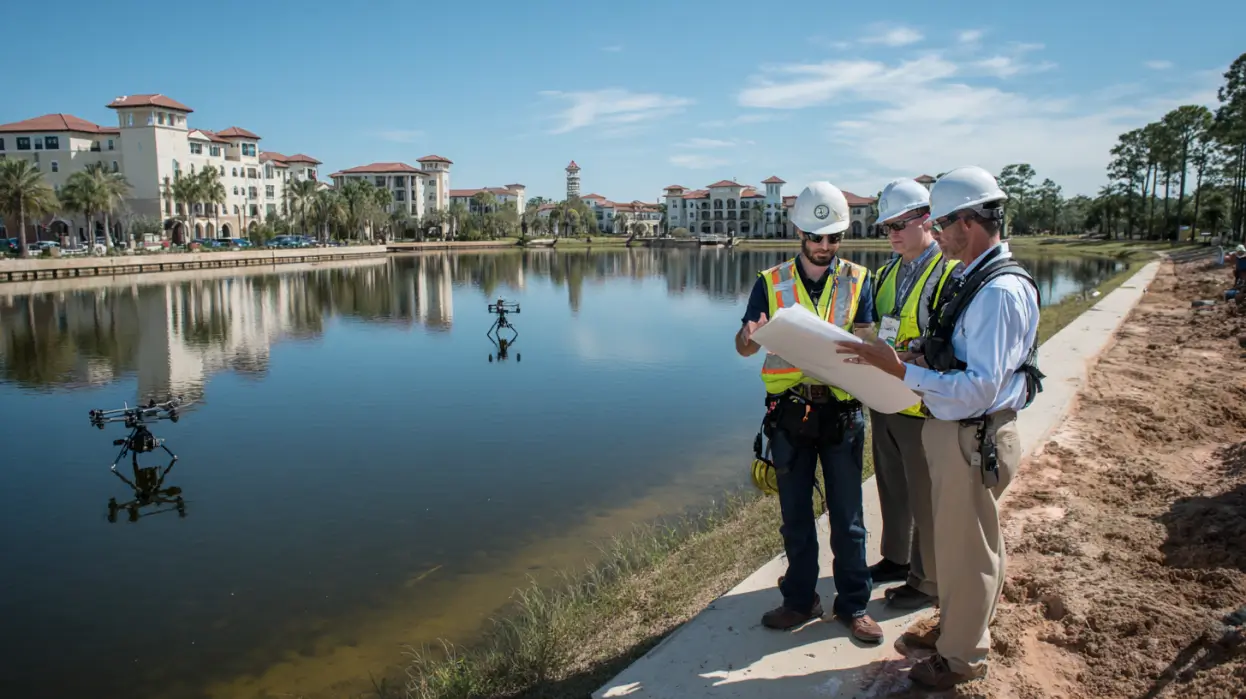
Once the purpose is set, the site itself needs a straightforward audit. How much space is available, and where will the audience actually stand or sit? Is there a reliable water source, or will the fountain need its own reservoir? What's the available power supply, and how far is it from the fountain basin? Local regulations around water use, noise, and electrical installation belong in this stage too, not later.
Budget range should be set here as well, even as a rough bracket. A fountain show's cost is driven mostly by scale, nozzle and lighting count, and choreography complexity — not by any single line item — so an early budget range keeps the design phase realistic instead of forcing a redesign after quotes come in.
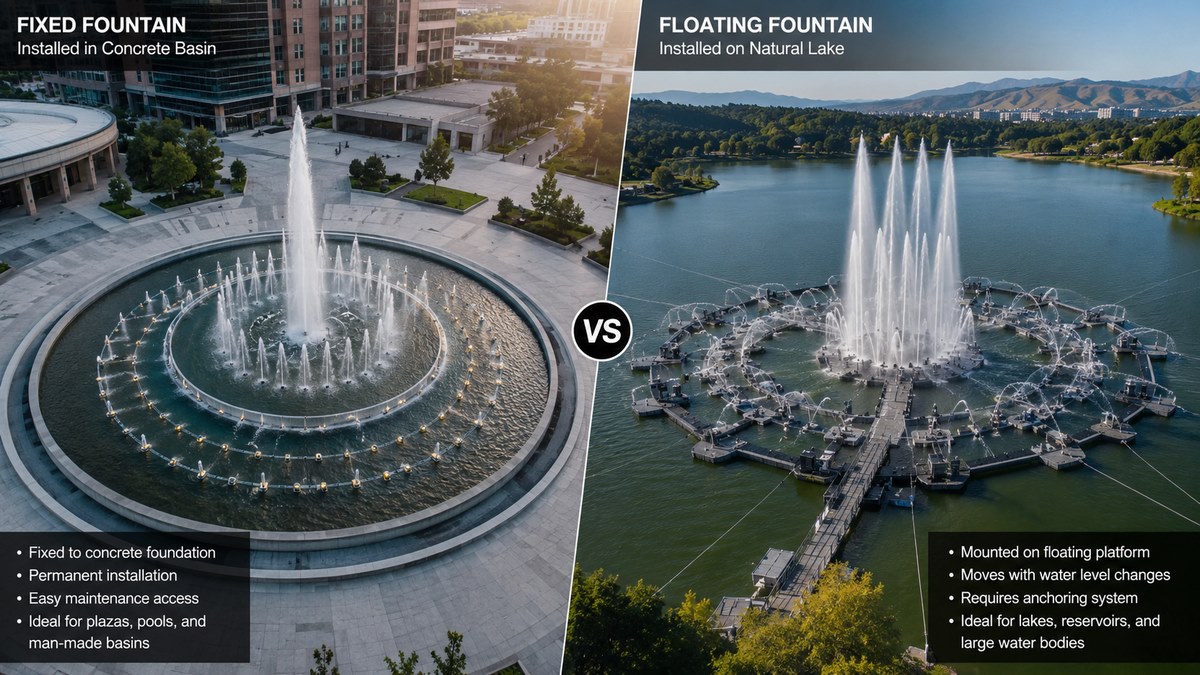
With the concept and site defined, the next decision is structural: should the fountain sit on a fixed base, or float on the water surface? Fixed fountains are anchored to a concrete or steel foundation. They suit plazas, entrances, and man-made pools where the basin can be built to spec, and they're generally easier to maintain because all plumbing and electrical runs stay accessible from a dry service area.
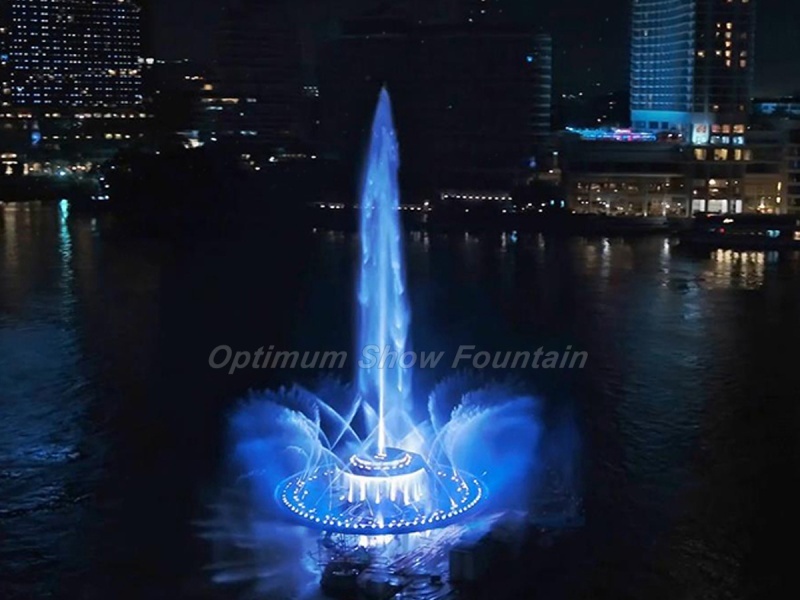
Structures built to ride the water surface instead work differently — this is where engineering a fountain to work on open water becomes the better option, particularly for lakes, reservoirs, and other natural water bodies where a fixed foundation isn't practical or would be prohibitively expensive. The platform needs to be engineered for water level changes — a natural lake can rise and fall by a meter or more across seasons, and the mounting system has to move with it without disrupting nozzle alignment or electrical connections.
The deciding factors are usually the water body itself and the budget. A natural lake with a soft, deep bottom almost always points toward a floating system. An artificial lake or pool with a hard, engineered bottom gives you the option to go fixed, which tends to cost less and simplify long-term maintenance.
Once the structure is settled, the equipment layout comes next: pumps, nozzles, and lighting. Pump capacity has to match the water volume and pressure the design calls for — undersized pumps flatten the visual effect, oversized ones waste energy and stress the plumbing. Nozzles fall into two broad categories: static nozzles that produce a fixed effect, such as jets, fans, or mist, and robotic nozzles that move in real time and give a show its three-dimensional, dancing quality. Most shows mix both, using static nozzles for the base pattern and robotic ones for the moments designed to stand out — the reasoning behind picking one jet type over another usually comes down to the height, water volume, and viewing distance decided back in Step 1.
Lighting typically goes in at the same stage, since fixtures are usually mounted at or near the nozzles. LED lighting is standard now for its color range and lower running cost, with the layout planned around which jets need to be lit individually versus in groups.

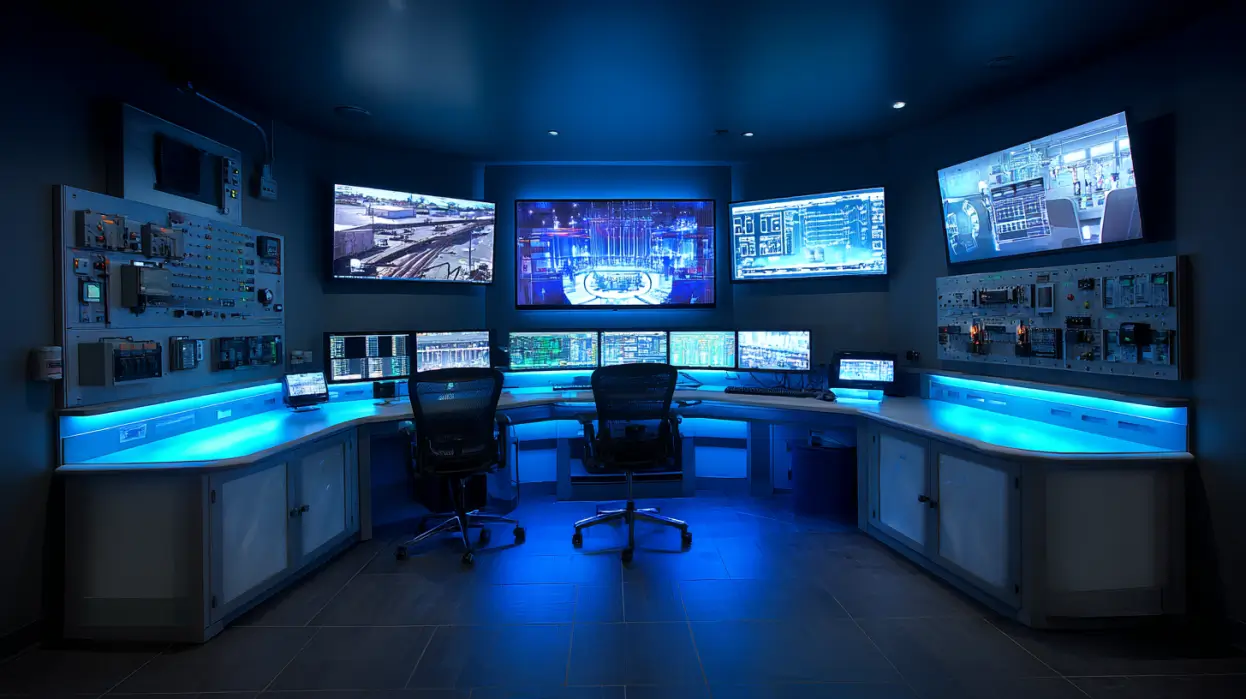
The control system turns a collection of pumps, nozzles, and lights into a fountain that can perform on cue. Most systems run on the DMX protocol, the same standard used in theatrical lighting, because it can address a large number of individual components — each nozzle and light — from a single control panel. Larger or more complex fountains sometimes use PLC-based control for grouped components instead, which can simplify wiring in bigger installations.
The panel itself houses the variable frequency drives, circuit breakers, and the main controller, and it needs to be sized for the number of channels the design requires — adding channels after installation is far more expensive than building in headroom from the start. Weighing DMX against PLC, and getting the panel sized correctly before equipment is ordered, is worth doing at this stage rather than after installation begins.
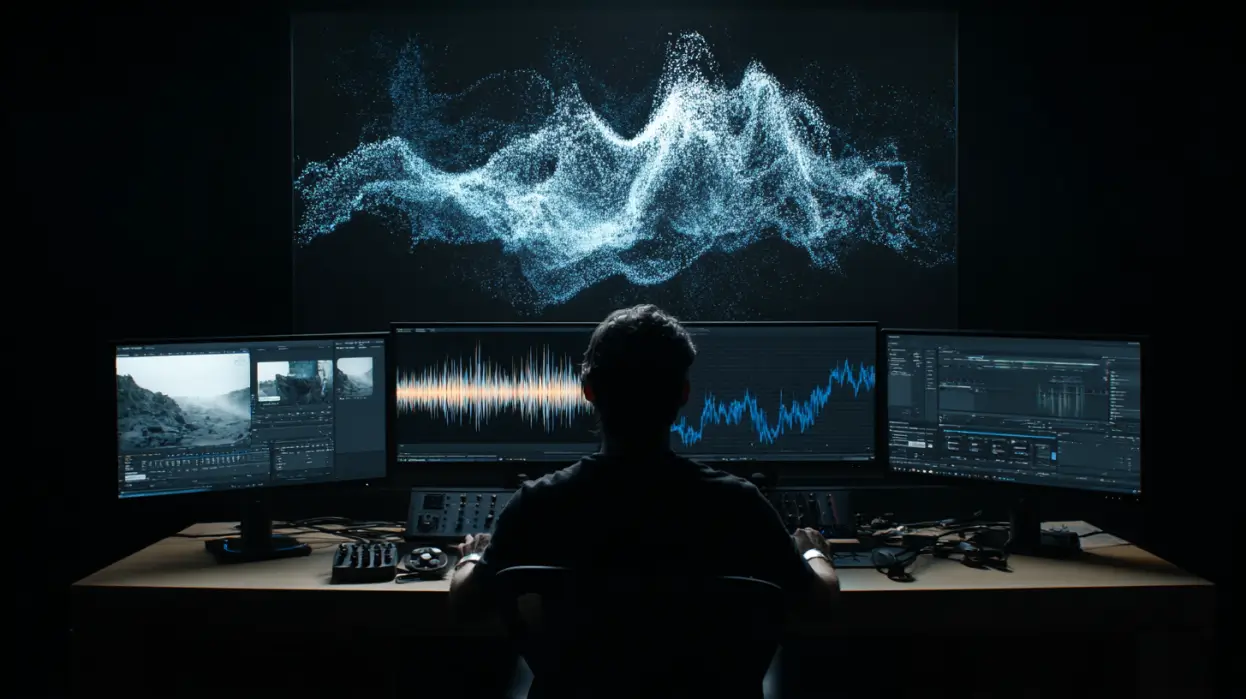
With the hardware and control system in place, the show itself gets programmed. Choreography software lets a designer map water movement, lighting changes, and sound to a piece of music on a timeline, effect by effect, rather than typing commands line by line. This stage typically overlaps with construction — programming a new show can take a week or more per three-minute song, so most teams start choreographing while the fountain is still being built rather than waiting until it's finished.
Good choreography also has a restraint problem built into it: it's easy to trigger every nozzle and light at once and end up with a display that feels busy instead of musical. Programmers generally build a show the way a composer arranges an orchestra, assigning specific effects to specific moments in the music instead of layering everything together at once — walking through how a show actually gets built from a piece of music makes this stage a lot less abstract than it sounds on paper.
Before any fountain equipment arrives, the site itself needs to be physically ready. For a fixed installation, this means excavation and foundation work — pouring the basin, setting the concrete or steel base, and running conduit for power and water lines. For a floating installation, mooring anchors and any shoreline infrastructure go in first, since the platform itself gets assembled once the anchoring system is confirmed.
A pump room or control room needs to be built or allocated at this stage too, sized for the equipment it will house and properly ventilated — pump rooms generate heat and need drainage in case of leaks. Electrical work at this stage covers bringing power to the site and installing grounding, while water supply and drainage or filtration lines get roughed in before the basin is sealed.
Site safety details are easy to overlook this early, but are cheaper to build in now than retrofit later: anti-slip surfacing anywhere the public will walk near the fountain, and clear access routes for the equipment delivery and installation crews that arrive next.
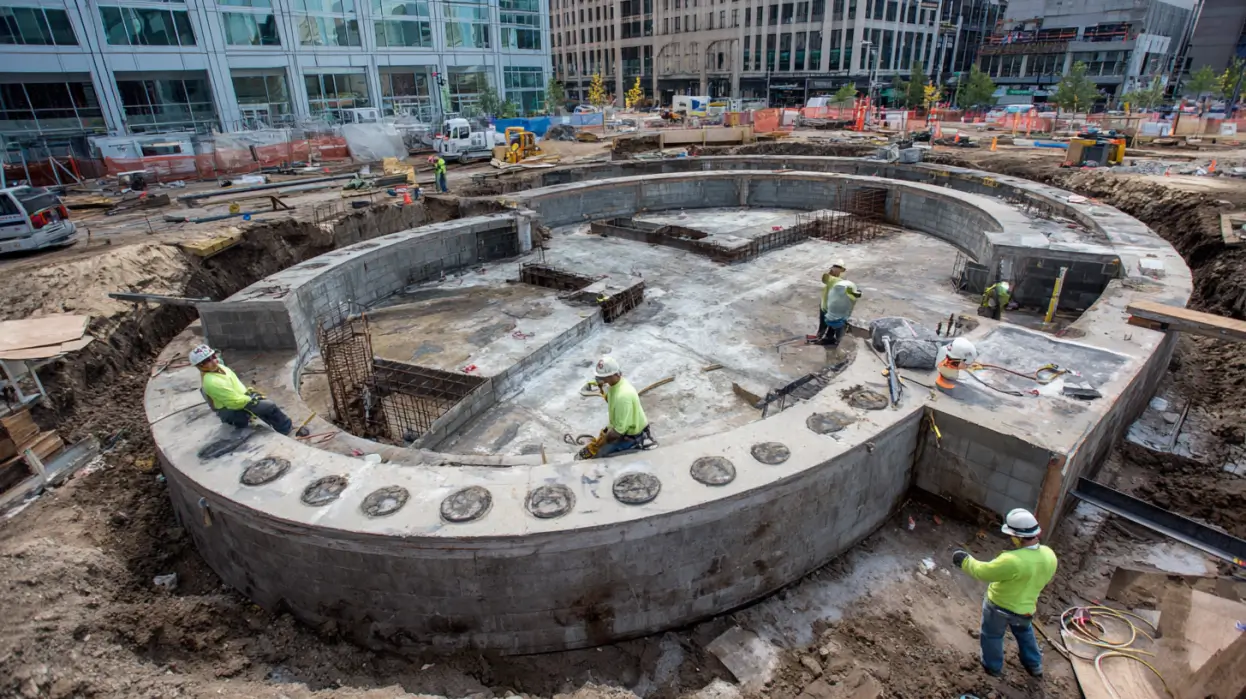
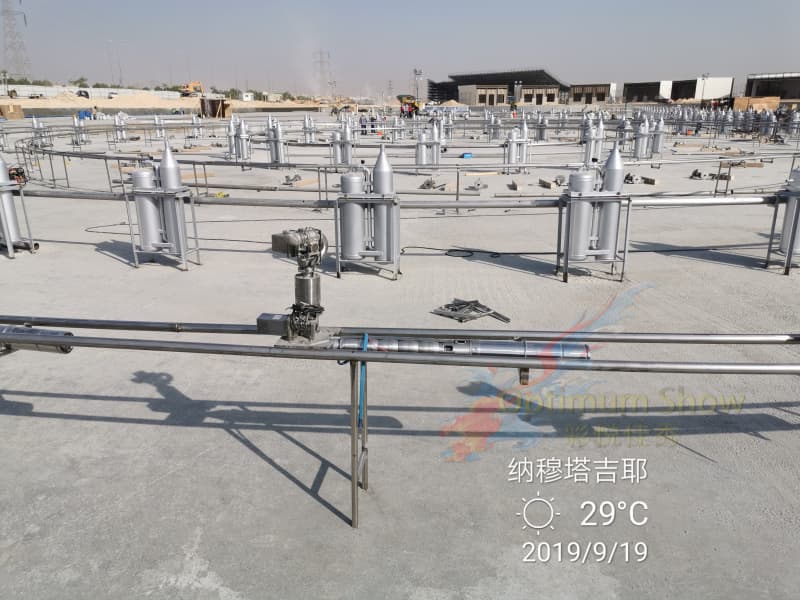
Once the site infrastructure is in place, the fountain equipment is installed. Pump lines are run and pressure-tested, while electrical crews pull cable to the control panel and terminate connections at each nozzle and light. Nozzles and lighting fixtures are then mounted and aligned according to the design layout — this step needs to be precise, since even small misalignments in nozzle angle become obvious once the fountain is running.
Equipment production and delivery — pumps, nozzles, control panels, and lighting — usually happens in parallel with the civil works above, once the design and contract are finalized, so the equipment arrives around the time site preparation wraps up. On a mid-size project, on-site installation with an engineer present commonly runs three to four weeks; larger or more technically complex builds take longer. Coordinating equipment lead times with site readiness is one of the more common sources of delay, so it's worth confirming both schedules early.
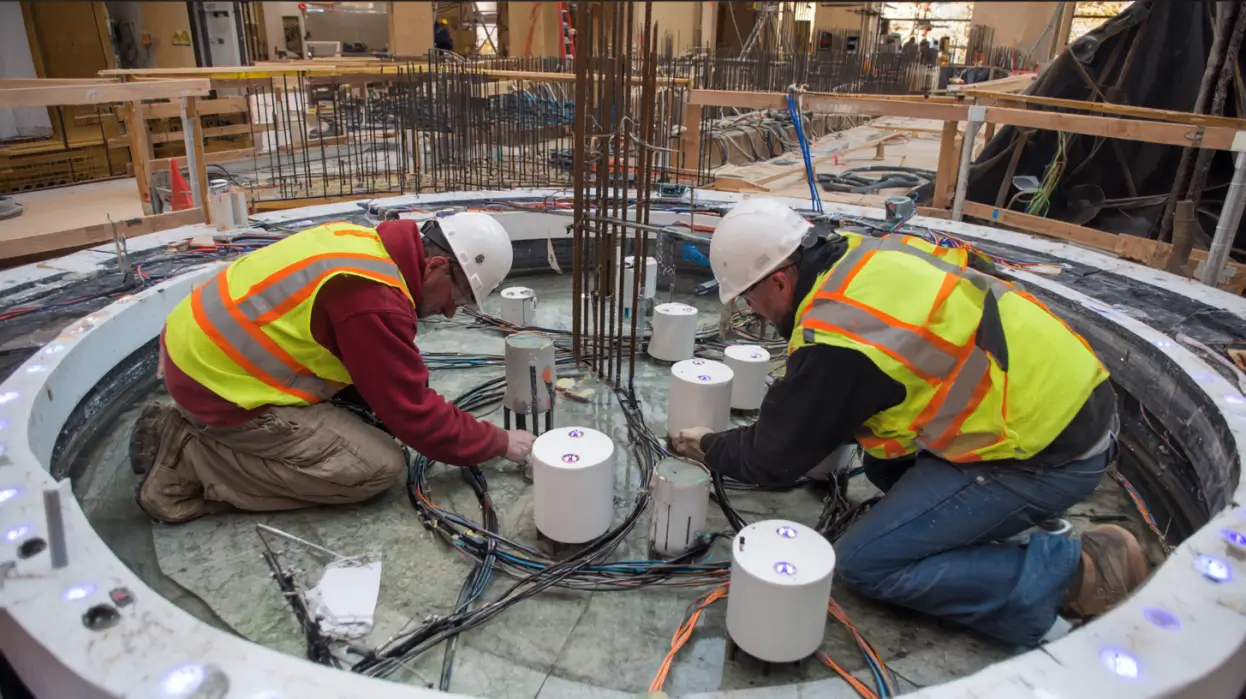
Once everything is installed, the fountain goes through testing before it's called finished. This starts with a dry check of all electrical and control connections, followed by a wet test with water running but no choreography active, to confirm every pump, nozzle, and light responds correctly on its own.
Commissioning is the next layer: running the actual programmed show end to end, checking that water, lighting, and sound stay synchronized, and adjusting nozzle timing or lighting cues where the physical result doesn't quite match the choreography software. Water pressure and flow often need small adjustments here too, since real-world pump performance can differ slightly from what a simulation predicted.
Testing is also when safety checks happen — electrical grounding, water containment, and any inspections required by local authorities. A fountain shouldn't move from commissioning to public operation until these checks are signed off, since problems caught here are far cheaper to fix than problems caught after opening.
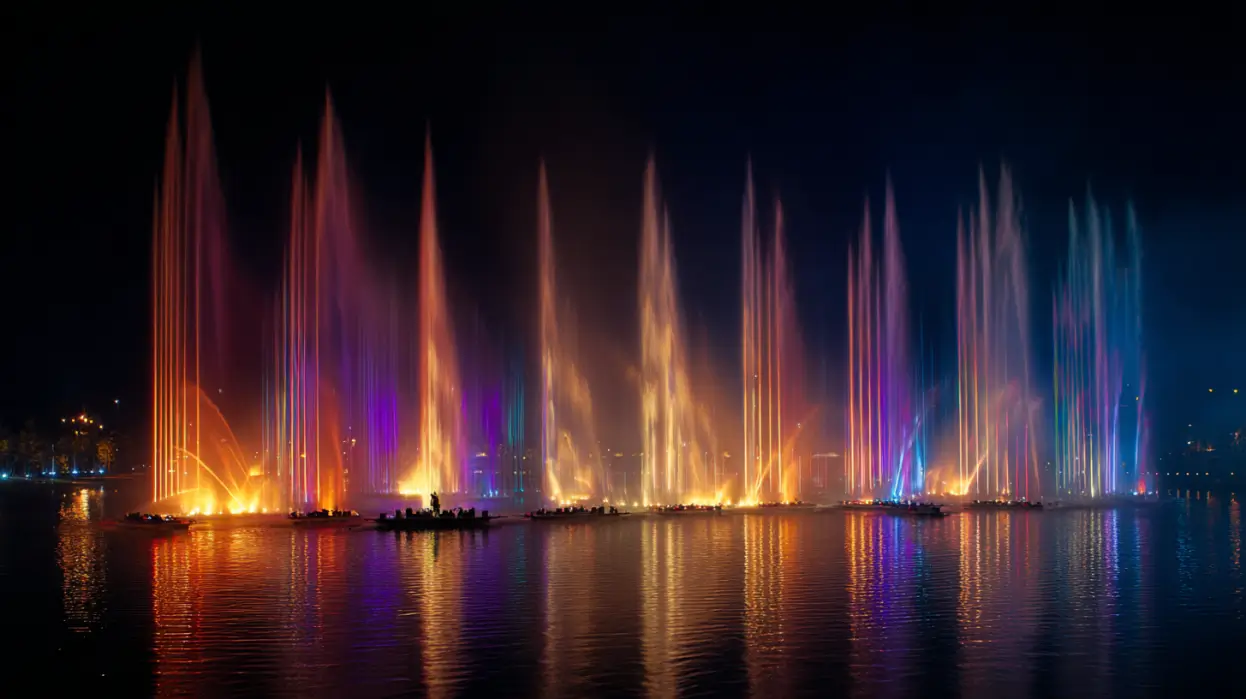
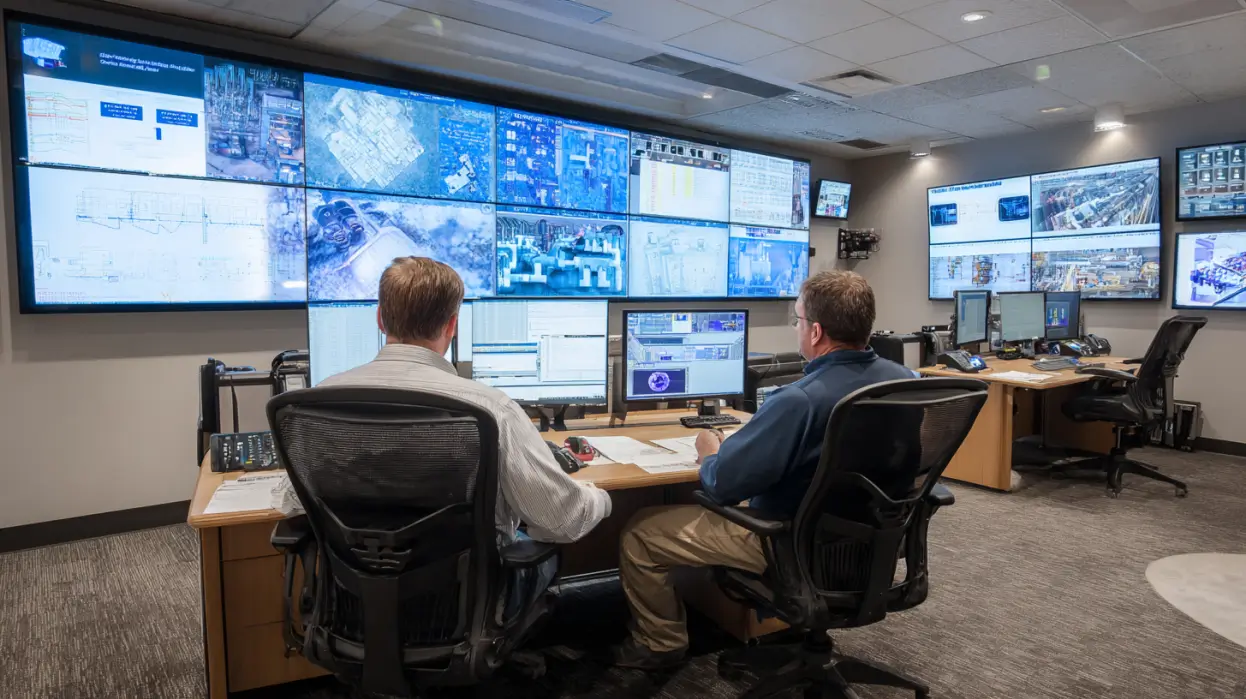
The final stage is handing the finished system over to whoever will run it day to day — a facilities team, a municipal operations department, or an on-site technician. This should include training on the control panel and basic troubleshooting, a maintenance schedule for pumps, nozzles, and lighting, and clear documentation of the choreography files so shows can be adjusted or updated later without starting from scratch.
Ongoing operation typically involves routine tasks: cleaning nozzles and light fixtures, checking water quality, and servicing pumps on a set schedule rather than waiting for a failure — knowing what a realistic upkeep schedule looks like before opening day saves a lot of guesswork later. Fountains that get regular maintenance tend to run for years with only routine part replacement; the ones that don't usually show problems — clogged nozzles, uneven lighting, drifting synchronization — within the first year or two.
Timelines vary by scale and complexity. Initial concept design can turn around in as little as a few days, with detailed choreography animation previews typically taking about a week to prepare.
From there, a straightforward fountain show can move from signed design to opening in a few months, while a large landmark installation with extensive choreography and multimedia elements can take closer to a year.
Breaking down how long each stage above typically runs, and where projects most commonly lose time, is worth a closer look once you have a rough scope in mind.
Cost is driven by a handful of variables rather than any single number, which is why fountain show pricing varies so widely between projects. Scale is the biggest factor — the size of the water feature and the number of nozzles and lights involved sets the baseline for equipment cost before anything else is considered.
Structure type matters too: a floating system for a large natural lake typically costs more than a fixed installation of similar size, because of the engineering required for the platform and mooring system. Choreography complexity is another variable — a fountain programmed with a handful of static effects costs less to develop than one with extensive robotic nozzle choreography synchronized across multiple songs.
Multimedia elements — water screens, laser projection, video mapping — add cost on top of the base fountain system, and they usually require their own control integration rather than simply plugging into the existing DMX setup. Water screen effects, in particular, are rarely a standalone system, so cost depends heavily on how well they integrate with the fountain's existing choreography and control platform rather than being a fixed add-on price. Site conditions move the number as well: difficult access, extensive excavation, or upgrading an existing power supply can add meaningfully to a project's total before any fountain equipment is even ordered. Since the underlying equipment overlaps heavily with dancing fountains, a lot of the same price drivers carry over and are worth checking against if you want more than a rough range.
Rather than looking for a fixed price per square meter, it's more useful to treat these variables as a checklist when comparing proposals. Two quotes that look far apart in price are often solving for different combinations of scale, structure, choreography, and multimedia.
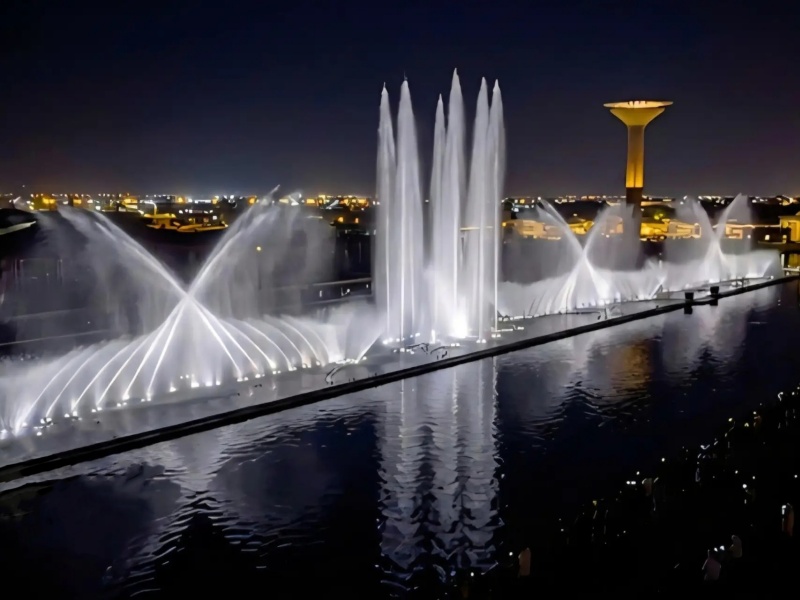
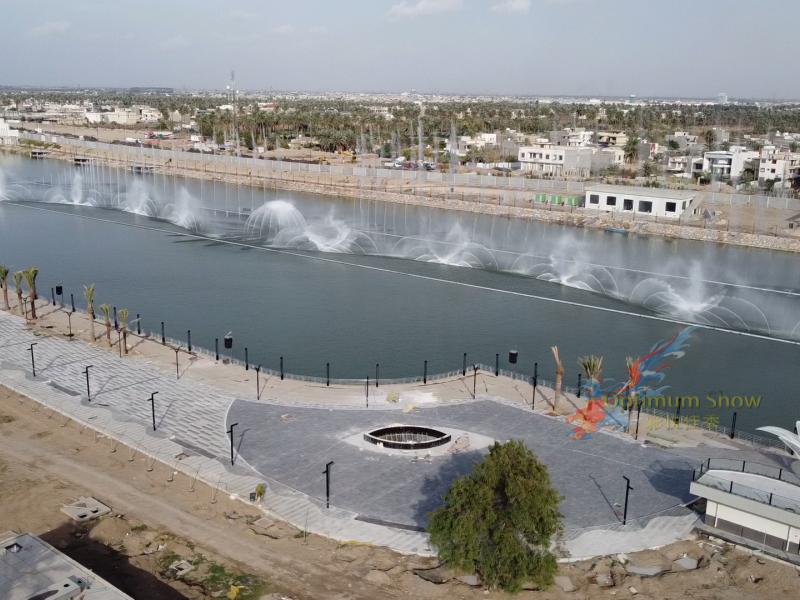
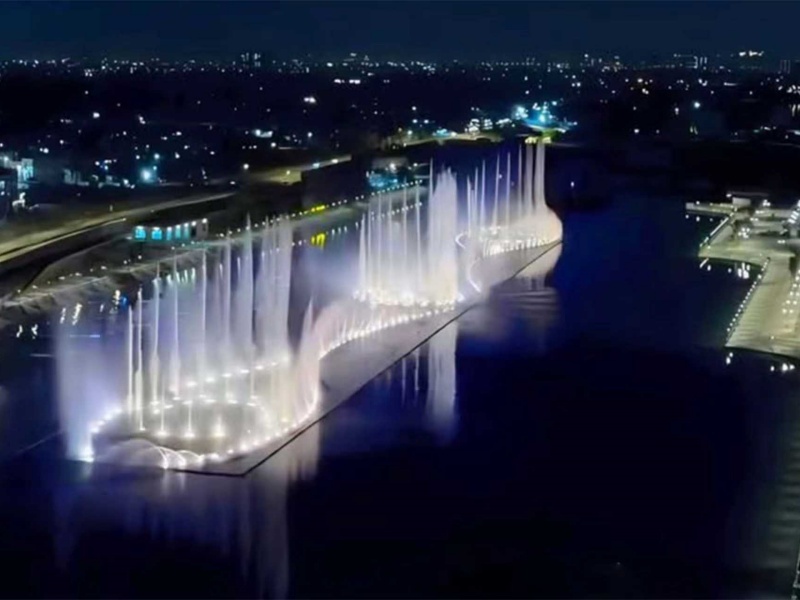
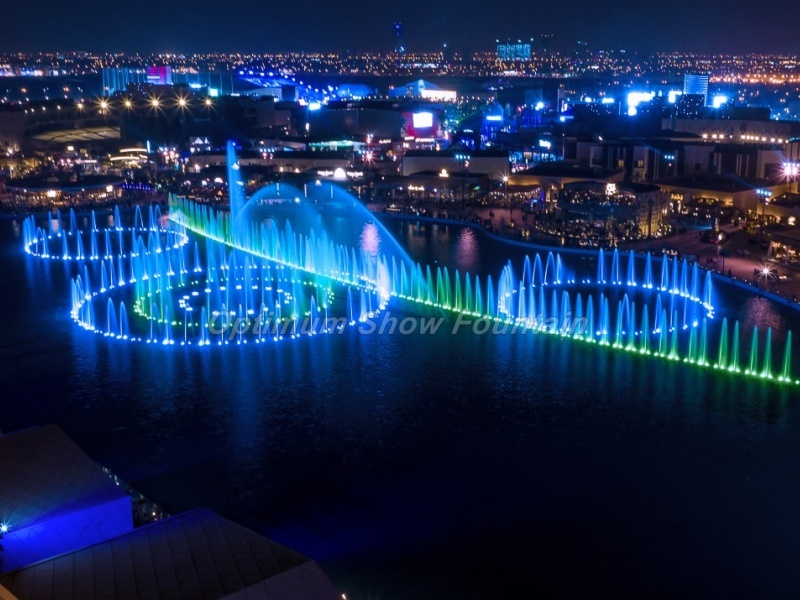
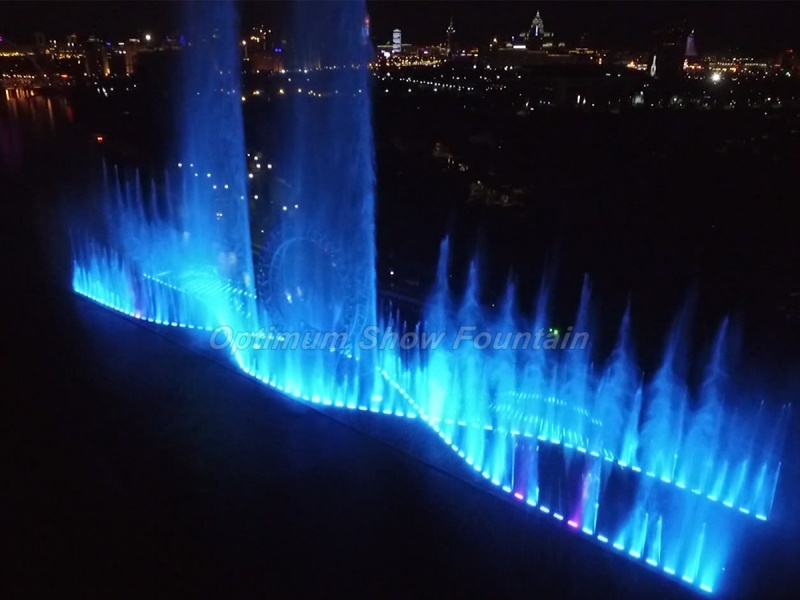
The floating fountain we built on Baghdad Island, Iraq is a useful illustration of how the structure decision in Step 2 plays out at real scale: the system spans roughly 300 meters in length and 33 meters in width, with jets reaching 80 to 100 meters, making it one of the longest fountains we've engineered in the Middle East. A project of that size still goes through the same sequence described above — site and water body assessment, structure choice, equipment and control system design, choreography, civil works, installation, and commissioning — just at a scale where each stage takes longer and carries more engineering risk.
Multimedia integration follows the same logic at a smaller scale, too. On a project at Taman Mini Indonesia Indah, our team combined water choreography with video mapping and a synchronized drone display, built around Indonesian folklore themes — an example of how the choreography and multimedia decisions in Step 5 and the cost section above compound once a project moves beyond a standard water-and-light show.
For a well-known external benchmark, the Dubai Fountain remains one of the most studied examples of what's achievable when every stage of this process is executed well.
A musical fountain synchronizes water, lighting, and show sequencing directly to music, while what's typically called a dancing fountain leans more on programmed water movement than on matching a specific song. Most modern installations combine both, using music synchronization as one mode alongside a non-musical cycling display.
Cost depends mainly on scale, structure type (fixed vs. floating), choreography complexity, and whether multimedia elements like water screens or projection are included. It's more accurate to request a quote based on your specific site and show requirements than to look for a fixed price per square meter.
A fountain show typically involves the project owner, an architect or landscape designer, a civil contractor for basin and site work, an electrical contractor, and the fountain supplier handling equipment, choreography, and testing. Coordinating these parties early — particularly around civil work timing and power supply — is one of the more common points where projects lose time.
At a minimum, a project needs a defined water source, an adequate power supply near the site, and enough space for the intended scale of the display. For natural lakes specifically, water level fluctuation and bottom conditions need to be assessed before deciding between a fixed or floating structure.
A modest installation can move from design to opening in a few months, while large landmark projects with extensive choreography often take closer to a year. Site conditions, equipment lead times, and how much choreography needs programming are the main factors that shift the timeline.
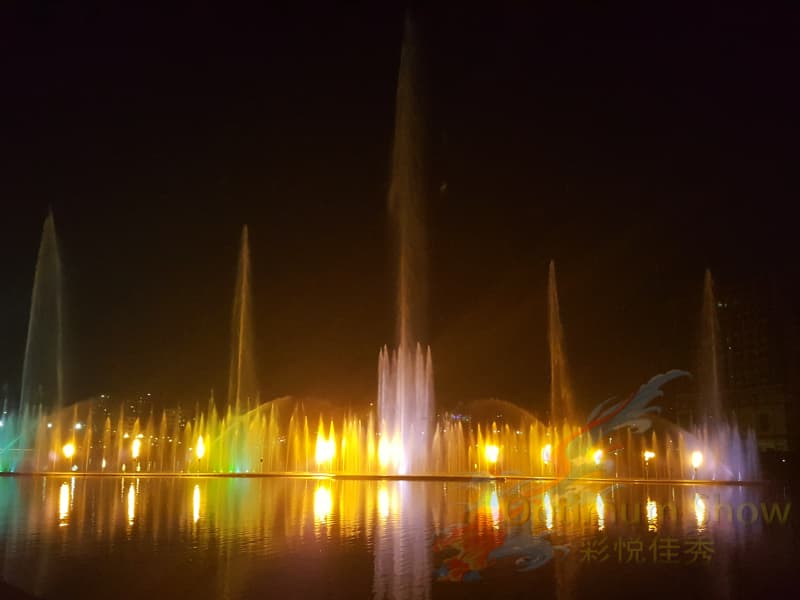
Share your site size, water depth, location or CAD drawing with our engineering team. We can evaluate the project requirements and recommend a suitable fountain system.