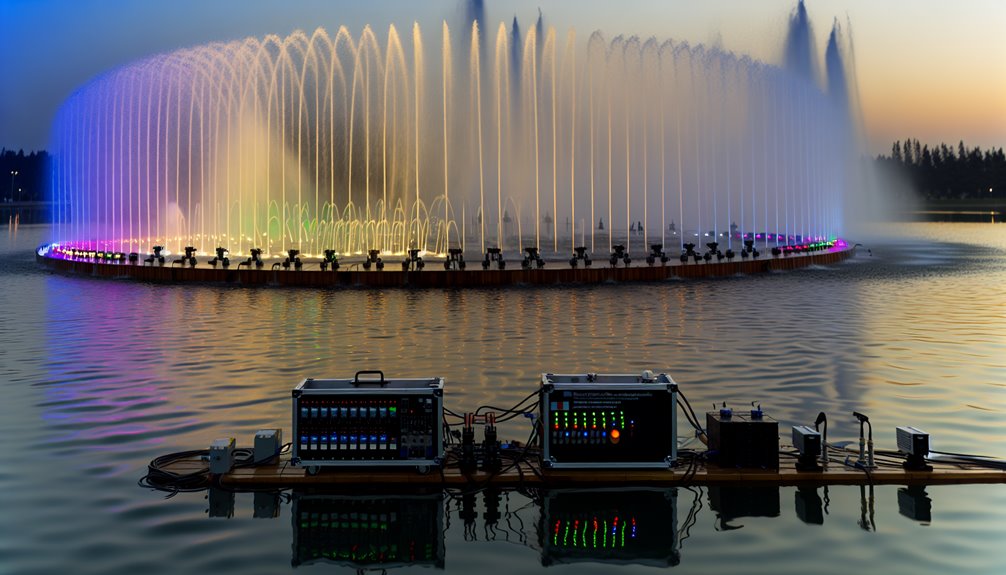
A musical fountain works by using a programmed control system to synchronize water jets, lighting, and music. Pumps generate the required water pressure, valves control when individual jets activate, nozzles shape the water effects, and RGB or RGBW lights illuminate them.
A central controller runs a pre-programmed show timeline. At specific points in the music, it sends commands to pumps, valves, moving nozzles, and lighting fixtures, creating the impression that the water is dancing to the soundtrack.
In larger systems, PLCs, VFDs, DMX or network-based control technologies may work together to manage hundreds or thousands of individual effects. The challenge is not simply playing water and music at the same time—it is accounting for hydraulic response, equipment latency, jet trajectory, lighting, wind, and other physical factors so the entire show appears synchronized to the audience.
A musical fountain is a programmable hydraulic, lighting, and audio system that synchronizes water jets and RGB LEDs to a defined musical timeline, whereas a static, ordinary fountain is a continuous-flow recirculation system designed for steady visual ambience at a fraction of the cost and control complexity.
Show logic maps music cues to pump speeds, valve states, and light color and intensity, achieving beat-accurate choreography. Ordinary units employ constant head, fixed nozzles, and simple pump cycling for low-maintenance operation.
Selection hinges on purpose, budget, and space: musical systems prioritize entertainment and updateability via software, while static systems prioritize reliability, simplicity, and minimal technical upkeep.
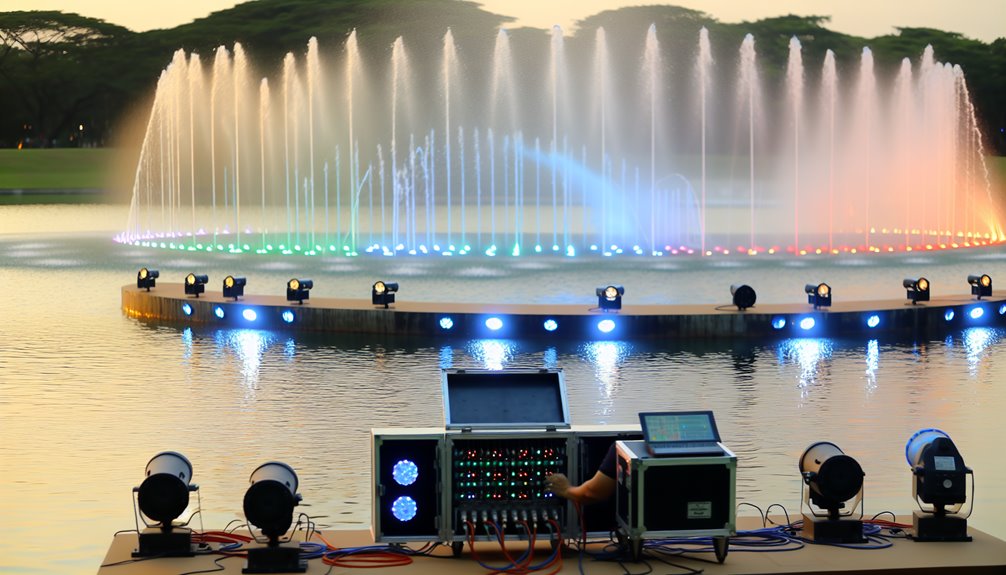
A musical fountain operates through four tightly integrated subsystems: a hydraulic network governing flow, pressure, and jet dynamics; an RGBW lighting array for visual synchronization; an audio chain for high-fidelity music playback; and a central control architecture (PLC/DMX/Show Control) for deterministic timing.
Pump curves, nozzle coefficients, and valve response times define water movement, while frame-accurate lighting cues and audio latency calibration guarantee coherent perception.
The controller orchestrates millisecond-level cues across devices, translating show timelines into commands that maintain synchronization under varying load and environmental conditions.
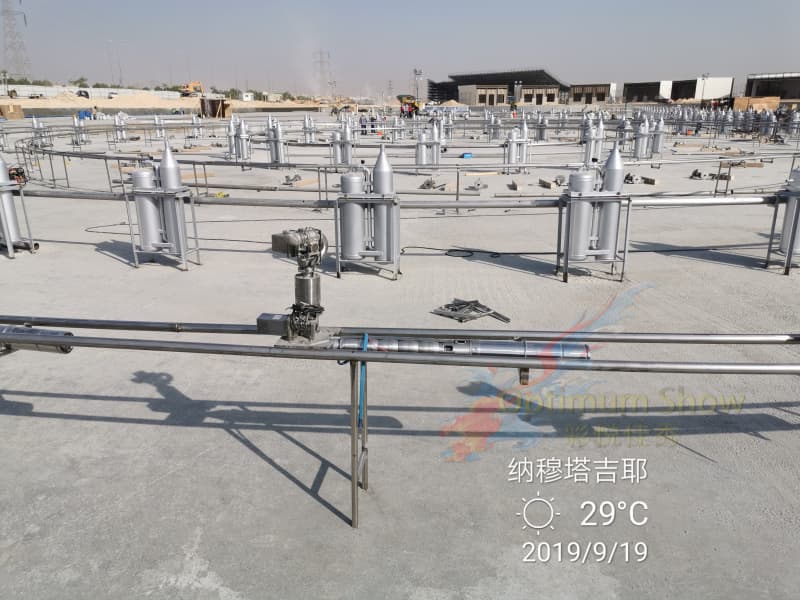
Steel manifolds, high-efficiency pumps, and calibrated nozzles form the hydraulic backbone that governs water movement and jet behavior in a musical fountain.
In explaining how musical fountains work, hydraulic design fixes flow paths, pressure losses, and response times so a programmable musical fountain can execute precise cues.
Pumps are sized for duty point efficiency and transient stability; manifolds are balanced to equalize pressure; nozzle orifices and angles are selected to shape turbulence, breakup length, and trajectory.
Variable-frequency drives modulate head, while fast valves gate flow in milliseconds, converting pressure profiles into repeatable jet dynamics.
Light serves as the second control plane, translating timing data into pixel-accurate color and brightness across submerged and perimeter luminaires.
In modern musical fountain technology, RGB LEDs provide wide-gamut rendering with per-channel PWM to modulate intensity and achieve smooth dimming. Fixtures are addressed individually or as groups via DMX, sACN, or PLC gateways, enabling deterministic frame-by-frame updates aligned to the show clock.
The dancing fountain control system computes cue states from timeline events, distributing synchronized setpoints for hue, saturation, and brightness.
Lookup tables linearize LED response; gamma correction preserves low-level detail. Waterproof drivers maintain constant current, while feedback on voltage and temperature supports derating and fault detection.
Optical geometry—beam angles, lensing, and placement—aligns emitted light with jet trajectories, maximizing visibility and minimizing spill and glare.
Audio infrastructure defines the temporal backbone of a musical fountain, providing synchronized music playback, deterministic timing references, and reliable distribution to amplification zones.
The audio system selects sound sources, aligns them to a master timing reference, and renders show tracks with low-latency routing to amplifiers and loudspeakers. Music playback is delivered from redundant players or servers, with sample-accurate clocks ensuring drift-free operation across zones.
Show tracks are curated, leveled, and limited to defined loudness targets.
Timing reference options include PTP, word clock, or LTC.
Building on the time-aligned playback backbone, the control system ingests the master clock and orchestrates deterministic cues across pumps, valves, lights, and auxiliaries.
At the core, a plc fountain control system executes hard real-time sequences for hydraulics and safety interlocks, while a DMX layer drives lighting and effect fixtures with millisecond precision.
Typical hybrid architectures separate concerns: PLC handles interlocks, pressure ramps, and valve timing; DMX/Art-Net manages color, dimming, and movement in the dmx musical fountain.
A supervisory show controller synchronizes both domains via a common timeline, distributing timestamps and cue packets.
Deterministic I/O scanning, sequence versioning, and heartbeat monitoring guarantee repeatability and fault containment.
Network segmentation, time synchronization (PTP/NTP), and buffered cue lookahead minimize jitter.
Operators gain deterministic playback, rapid recovery, and maintainable, updateable shows.
A musical fountain is essentially a real-time control system that converts an audio timeline into precisely timed commands for water and lighting equipment. While the show looks artistic, the operation is built on a repeatable workflow that runs the same way every time a programme is triggered.
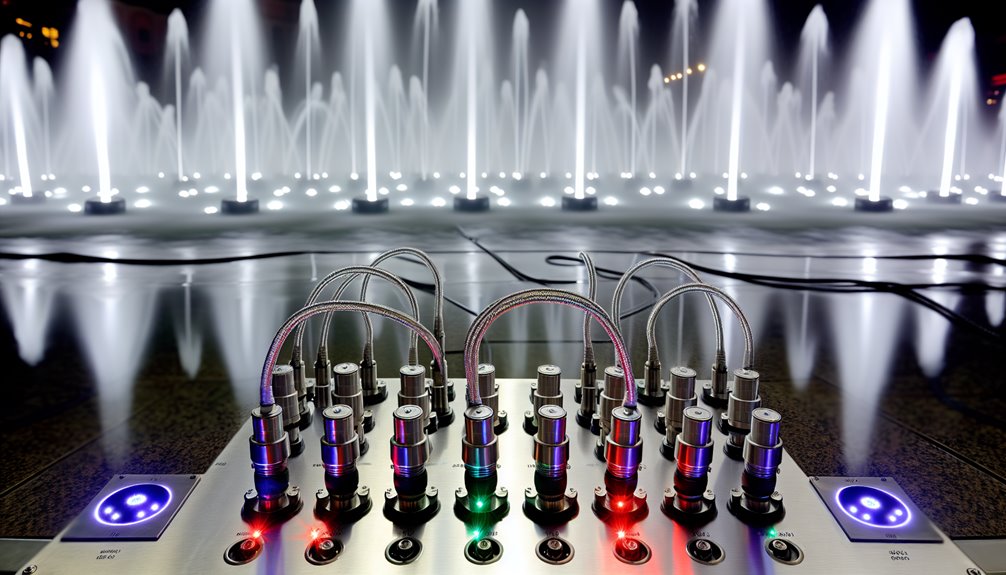
The process starts with a chosen soundtrack (or a setlist) and a show file that defines when each effect should happen—jet bursts, valve changes, colour transitions, and scene changes. In professional systems, this timeline is not “improvised”; it is programmed so the fountain can replay the performance consistently across daily shows and special events.
When the show begins, a central controller (often a PC-based show server, PLC, or hybrid controller) acts as the master clock. This timing reference is what keeps water, lights, and music aligned. The controller continuously tracks the timeline in milliseconds, ensuring the fountain does not drift out of sync over time.
As the timeline runs, the software converts each programmed cue into control instructions such as:
These commands are created ahead of the exact moment they must execute, so the system can deliver smooth transitions rather than late reactions.
The controller then sends instructions to the field through one or more communication layers, such as:
In larger fountains, devices are split into zones, each with local interface modules, so long cable runs do not compromise response time or signal stability.
Once commands reach the hardware, the physical systems respond:
In well-designed systems, water and light are treated as a single choreography layer—lighting cues are timed to the expected jet rise and fall, not simply triggered at the same moment.
While the programme runs, safety and automation systems operate in parallel. Common protections include:
This layer is critical in public installations, where reliability and risk control matter as much as visual impact.
At the end of the programme, the controller executes a shutdown sequence:
The system then remains ready for the next scheduled performance, which can be triggered automatically via a timer/calendar or manually by operators.
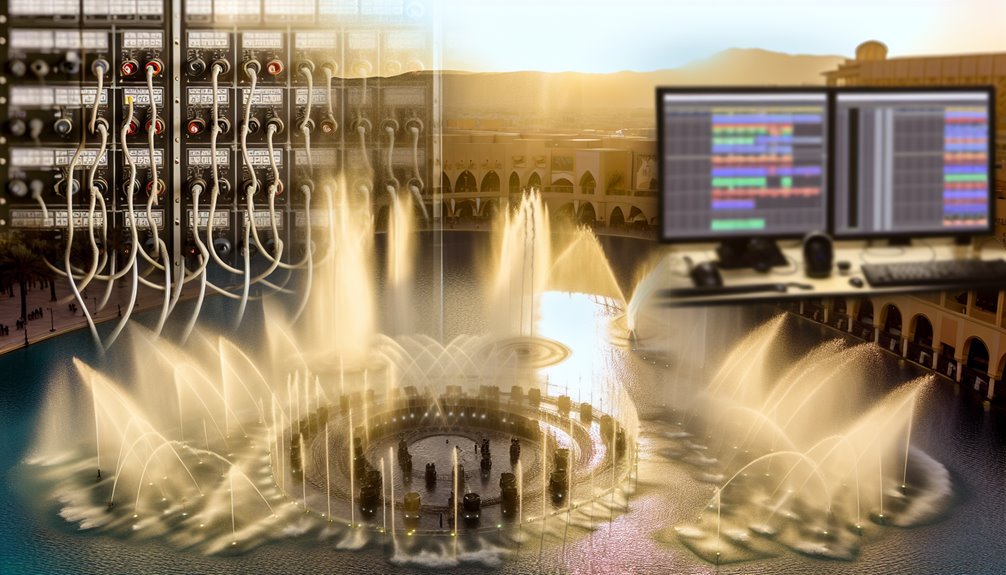
At a high level, musical structure — beats, bars, and phrase changes — is mapped to predefined control events that determine when jets activate, how high they rise, and how lights change in colour or intensity, with hydraulic and electrical limits applied so the choreography never exceeds pump capacity or nozzle stability. The specific technique behind that translation — jet tiering, cue density, colour-to-section mapping — is what musical fountain design actually consists of.
What matters at the systems level is timing accuracy: latency is carefully managed across audio playback, control processing, network transmission, and actuator response so that water and light movements stay visually synchronized with the music to the human eye.
Musical fountains rely on two primary control technologies: DMX for high-channel, fast-response visual effects, and PLCs for deterministic control of pumps, valves, and safety logic. Each serves a distinct role within the system architecture.
DMX delivers rapid, frame-based updates across hundreds or thousands of addresses, making it ideal for RGB lighting and fast-acting effects. PLCs, by contrast, provide stable, logic-driven sequencing, robust I/O handling, and safety-rated interlocks tailored to hydraulic systems.
Modern installations commonly use hybrid DMX–PLC architectures, where both systems are synchronised via timecode or networked show control. This approach combines visual flexibility with mechanical reliability, enabling precise, scalable, and fault-tolerant operation.
DMX512 is the standard protocol for controlling lighting and high-speed effects in musical fountains. A central show controller converts music cues—derived from beat markers or frequency analysis—into DMX channel values, typically refreshed at around 40–44 Hz.
RGBW luminaires and auxiliary effects respond through PWM dimming and colour mixing, allowing intensity and colour to track musical dynamics in real time. DMX universes are segmented to reduce latency, while opto-splitters and repeaters preserve signal integrity in electrically noisy, water-exposed environments.
Timecode ensures that audio playback and DMX timelines remain aligned, producing consistent and repeatable shows with clearly defined visual accents.
PLCs form the operational backbone of musical fountains, managing pumps, solenoid valves, and mechanical actuators under deterministic, safety-rated logic. They execute timed sequences based on music-derived targets while enforcing interlocks for water level, pressure, temperature, and motor protection.
Low-frequency musical cues typically drive high-flow pumps and large nozzles, while higher-frequency cues activate smaller jets via fast solenoid valves. PLC programs handle soft starts, ramping, and fail-safe shutdowns to protect equipment and maintain stable jet behaviour.
Integrated diagnostics, alarms, and maintenance counters support long-term reliability and lifecycle planning—critical for public and landmark installations.
In hybrid systems, PLCs govern safety-critical hydraulics, while DMX networks control lighting and rapid visual effects. Audio-derived data is split logically: bass and sustained cues drive pump ramps via PLC logic, while high-frequency elements trigger fast jets and lighting effects through DMX.
Synchronisation is maintained using SMPTE, MIDI, or network-based timing protocols, ensuring water, light, and audio remain tightly aligned. This architecture allows large jets to operate safely and predictably, while finer effects respond instantly to musical detail.
Hybrid control delivers the balance most large-scale musical fountains require: visual richness, mechanical safety, and operational resilience.
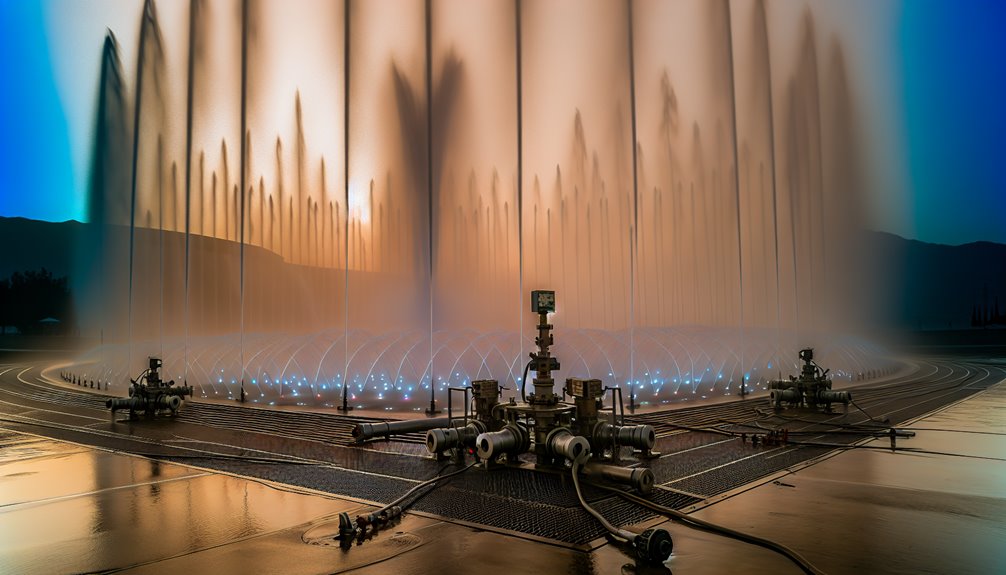
Accurate musical fountain performance depends on millisecond-level coordination across water, lighting, audio, and control systems. This precision is achieved through a centralised timing architecture built on deterministic clocks, timecode, and continuous verification.
A master clock—typically PTP (Precision Time Protocol) or GPS-disciplined—distributes a unified timebase to PLCs, DMX nodes, audio playback systems, and media servers. SMPTE or MIDI timecode locks music transport to control timelines, preventing drift between sound, lighting, and water effects.
Control execution is scheduled using fixed-cycle logic. PLCs operate on predictable scan times (for example, 50–100 ms), while DMX and networked lighting cues are triggered at sub-millisecond resolution. Phase offsets are calibrated to account for network latency, valve response time, and pump inertia.
Timing integrity is continuously validated through round-trip latency checks, PTP/NTP statistics, and cue-to-event telemetry from field devices such as pressure sensors and flow meters. This feedback confirms that commanded effects occur exactly when intended.
Jitter is minimised using timestamped commands, buffered look-ahead queues, Ethernet QoS prioritisation, and redundant network paths. In the event of clock or network disruption, holdover oscillators maintain acceptable synchronisation until normal timing is restored—ensuring uninterrupted show continuity.
Precision in musical fountains is achieved by components engineered for low latency, high bandwidth actuation, and deterministic control. Fast, repeatable motion depends on tight integration between hydraulic hardware, power electronics, and real-time control buses that convert music-derived commands into physical effects within milliseconds.
Core elements include responsive pumps, electronically throttled valves, optimized nozzles, and DMX/PLC controllers executing time-stamped sequences synchronized to audio analysis.
Together, these subsystems translate signal processing into reliable, precise motion.
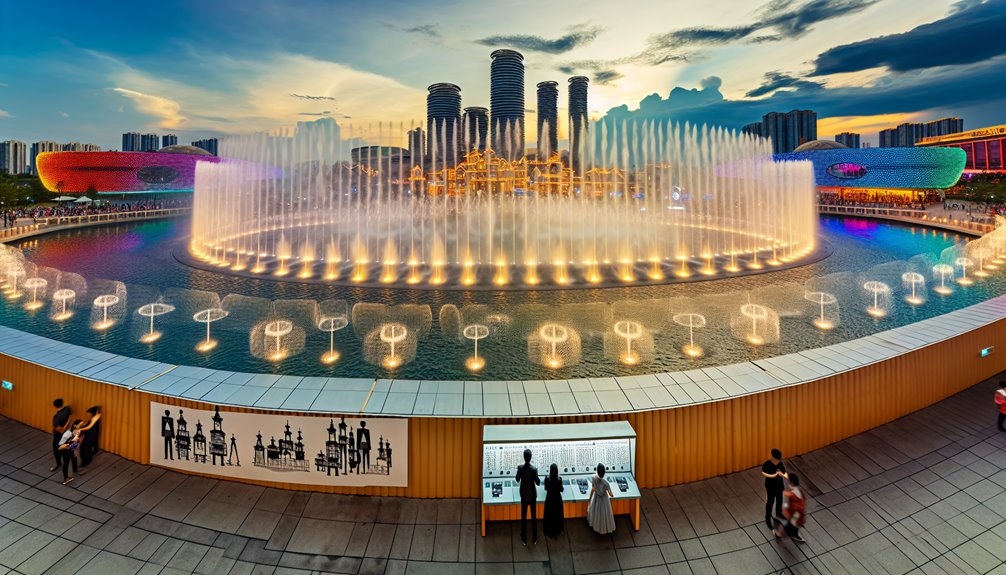
Operational models scale from compact, low-flow, DMX-only systems in small plazas and commercial Operational architecture scales with project size, not just visual ambition. Small plazas and commercial sites typically run compact, low-flow, DMX-only systems with quiet VFD pumps and efficient RGB LEDs, where programming favours concise, beat-tracked cues suited to short viewing distances, and reliability comes from modular manifolds and simplified filtration for high-uptime retail hours. Dry-deck and outdoor installations in this tier are commissioned around nozzle alignment, gain-staged audio, and end-to-end latency verification.
At urban-square and public-waterfront scale, systems shift to distributed, networked arrays: multiple VFD pump clusters feed independent rings and linear runs, each with pressure sensors and fast valve actuators to hold response under crowding and wind, while DMX/PLC hybrid control partitions cues by zone so a fault in one section doesn't degrade the full scene.
At the largest scale — large lake and landmark shows — architectures move to segmented hydraulic zones, redundant VFD pump farms, and synchronized DMX/PLC networks with sub-10 ms timing across hundreds of meters. Show logic adds beat detection and AI-assisted cueing to align jets, lights, and valves under wind, level, and load constraints, with remote operations and predictive diagnostics maintaining availability. Performance metrics — jet height envelopes, luminance, sound coverage, maintenance intervals, and energy per show — increase nonlinearly with footprint and audience radius, which is why commissioning at this scale focuses heavily on nozzle alignment, latency calibration, and resilient power-water distribution.
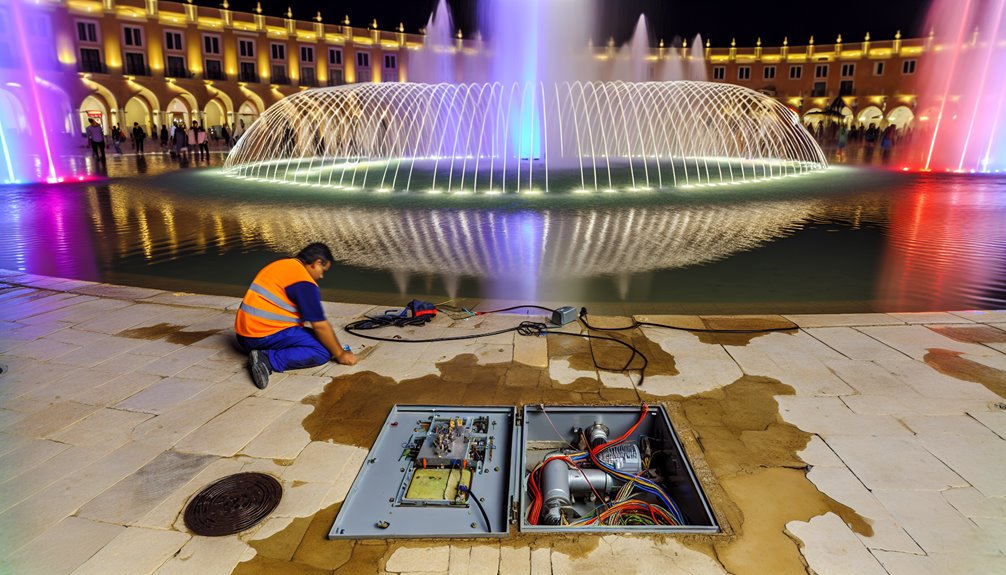
The performance of a musical fountain is governed by interconnected constraints across hydraulics, control systems, acoustics, structural design, and power availability. These factors define the system’s achievable jet height, responsiveness, stability, and reliability.
Hydraulic limits set the upper boundary of jet height and shape. As scale increases, pump head, pipe friction, valve response time, and nozzle coherence become dominant factors, while wind shear increasingly disrupts tall jets.
Control constraints—including DMX and PLC latency, update rates, and synchronization accuracy—limit how finely water and lighting effects can follow musical detail.
Acoustic performance must overcome ambient noise, wind, and spray sound while maintaining even coverage for spectators.
Structural considerations include resistance to vibration, dynamic loading, wind forces, and long-term corrosion.
Power budgets must accommodate simultaneous pump starts, lighting peaks, and audio loads without voltage sag or instability.
| Domain | Primary Constraint | Typical Mitigation |
| Hydraulics | Head loss, cavitation, wind shear | Larger pipe diameters, VFD tuning, nozzle optimisation |
| Controls | Latency, jitter, update limits | Timecode synchronisation, buffered cues |
| Acoustics | SPL loss, uneven coverage | Zoning, directional or cardioid speaker arrays |
| Structural | Vibration, resonance, wind load | Dampers, reinforced mounts, CFD-informed layouts |
| Power | Demand spikes, voltage drop | Sequenced starts, power-factor correction |
Understanding these constraints early allows designers to align choreography ambitions with physical reality—avoiding unstable effects, excessive energy use, and premature component wear.
Musical fountains are cyber-physical systems in which hydraulics, control logic, acoustics, structural design, and power infrastructure are tightly interdependent. Achieving reliable operation, safety compliance, and consistent show quality therefore requires the kind of professional, system-level dancing fountain design that treats these subsystems as one integrated build, not isolated component selection.
Specialist designers translate site constraints, environmental conditions, and show objectives into an integrated technical architecture. This includes correctly sizing pumps and filtration systems, selecting nozzles and RGB luminaires, defining PLC and DMX control networks, and calibrating audio output to water movement and lighting dynamics.
A turnkey engineering approach reduces commissioning risk, keeps projects aligned with budget and schedule, and ensures long-term maintainability through accessible layouts, structured diagnostics, and planned spare-parts strategies.
Data-driven programming and formal acceptance testing validate synchronisation accuracy, electrical loading, and hydraulic stability across all operating modes—normal shows, peak events, and fault scenarios.
Well-designed systems deliver measurable outcomes:
Professional system design turns a musical fountain from a fragile spectacle into robust, long-term infrastructure.
With professional system design establishing reliability and synchronization tolerances, deployment patterns cluster in locations where footfall, sightlines, and acoustic propagation justify capital spend.
City squares, waterfronts, and parks leverage high visitor density and broad viewing arcs to maximize show reach. Commercial venues—malls, resorts, hotels—use programmable content to extend dwell time and reinforce brand identity.
Cultural districts and event plazas benefit from schedule-driven shows that align with festivals and peak visitation. Lakes and rivers provide dark backgrounds and distance for large-scale vertical jets and beam angles, improving luminance contrast and sound dispersion.
Indoor atriums adopt smaller, low-spray envelopes for HVAC compatibility and reverberation control. Across contexts, DMX/PLC control, LED efficiency, and recirculating hydraulics support operational uptime, content refresh, and measurable economic uplift.
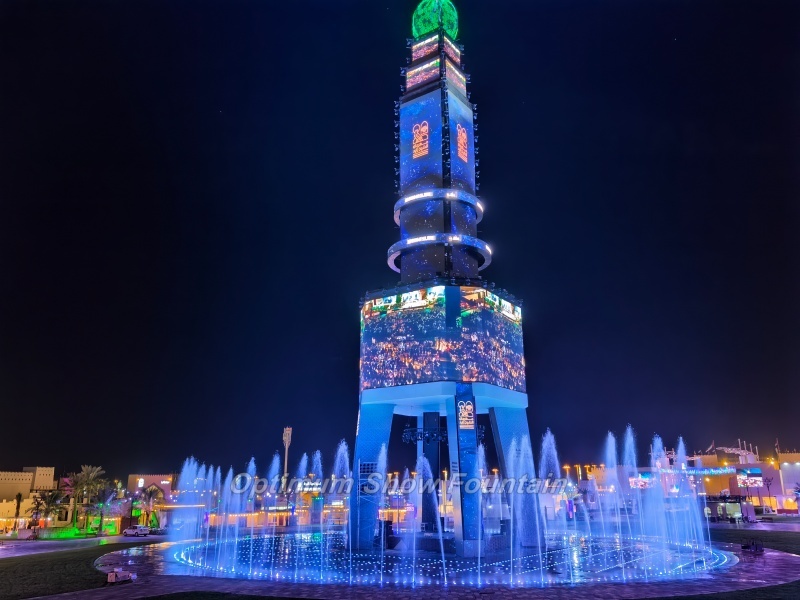
At Optimum Show, we are chosen for musical fountain projects where technical execution, reliability, and long-term performance matter as much as visual impact. We work as a single accountable manufacturer and partner, integrating design, engineering, manufacturing, installation, programming, and ongoing support into one coordinated workflow.
Our team delivers complete systems—from concept development and 3D previsualisation to factory fabrication, on-site commissioning, and DMX/PLC show programming—ensuring that hydraulics, lighting, audio, and controls perform as one stable, synchronised system. Lifecycle considerations such as energy efficiency, maintenance access, and operational reliability are built into every design decision.
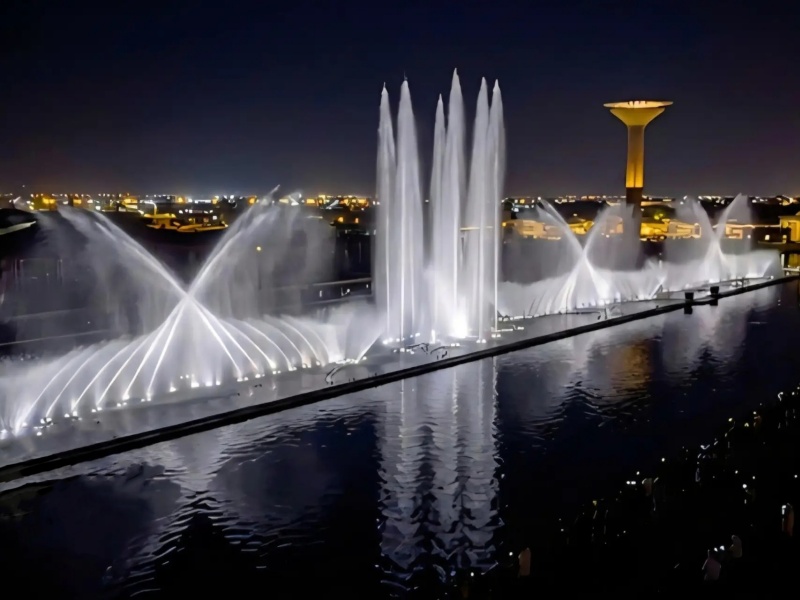
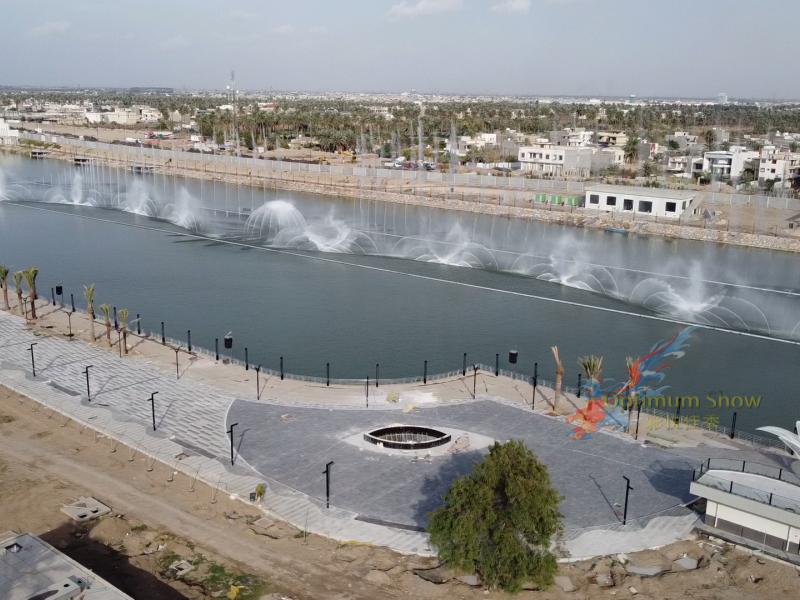
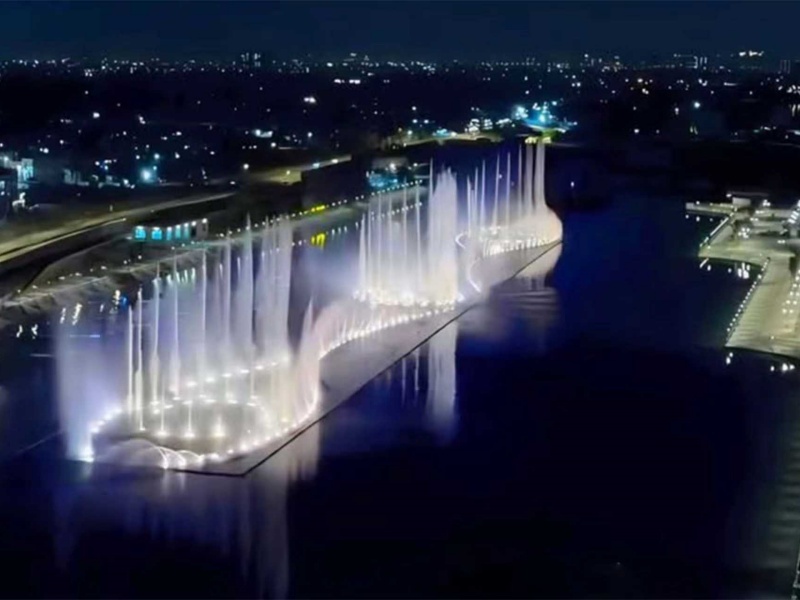
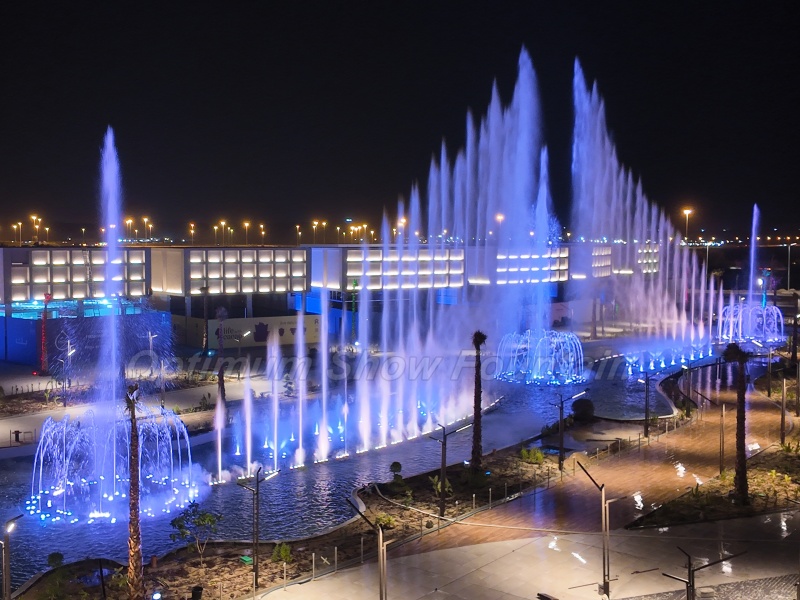
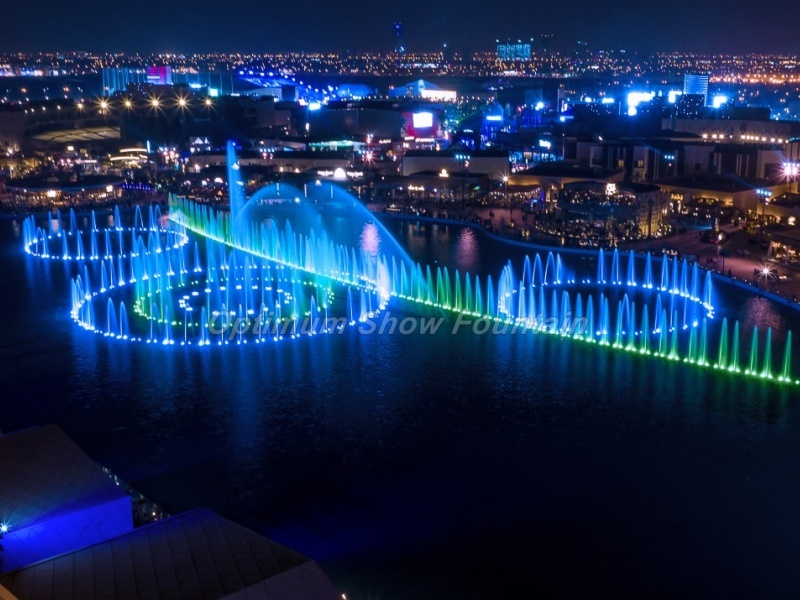
Projects such as Sheikh Zayed Festival, Riyadh Boulevard City, and Baghdad Island reflect our ability to deliver large-scale urban fountains with precise timing, low downtime, and efficient operation through optimised hydraulics and LED-based lighting systems.
If you are planning a musical fountain and need a system that performs reliably—not just on opening night, but for years—our team is ready to support your project from concept to operation.
Contact Optimum Show to discuss your site, performance goals, and technical requirements.
Musical fountains require daily visual checks, weekly filter and nozzle cleaning, monthly pump and control diagnostics, quarterly water balancing, and annual overhauls. Typical operating costs are 5–10% of CAPEX per year, with pumps lasting 7–10 years, LEDs 5–7 years, and controllers 10–15 years.
Water quality is managed through closed-loop recirculation, multi-stage filtration, automated ORP-controlled chlorination (about 650–750 mV), and often UV treatment. Turbidity is kept below 2 NTU, with routine testing and documented compliance to meet public health requirements.
Permits typically include building, electrical, plumbing, and water-use approvals, plus noise, lighting, public health, structural, environmental, and accessibility compliance. Requirements vary by jurisdiction and should be confirmed early in project planning.
Noise is controlled using directional speakers, low-noise pumps, DSP zoning, sound barriers, and defined operating limits. Acoustic modelling and real-time monitoring help maintain compliance at nearby properties and sensitive receptors.
Uptime is protected through N+1 pumps, dual power feeds with UPS or generators, redundant PLCs and networks, DMX failover, backup audio paths, and real-time system monitoring with predefined safe fallback modes.
You may also like: How to Build a Fountain Show
At its core, a musical fountain is a disciplined exercise in systems engineering, where water, light, and sound are coordinated with the precision of industrial control. Hydraulics define trajectories, lighting systems translate cues into colour and intensity, audio provides the temporal reference, and the control platform arbitrates every action with deterministic logic.
Performance is shaped by real constraints—pressure loss, control latency, component ageing, and power limits—but when these are engineered correctly, they disappear from view. What remains is a seamless public experience that feels spontaneous, emotional, and effortless.
This is the paradox of successful musical fountains: joy is engineered, synchronisation is calculated, and reliability is designed in from the start. With the right architecture, timing discipline, and redundancy, even complex, high-energy spectacles can meet strict operational targets while appearing entirely natural to the audience.
Share your site size, water depth, location or CAD drawing with our engineering team. We can evaluate the project requirements and recommend a suitable fountain system.